
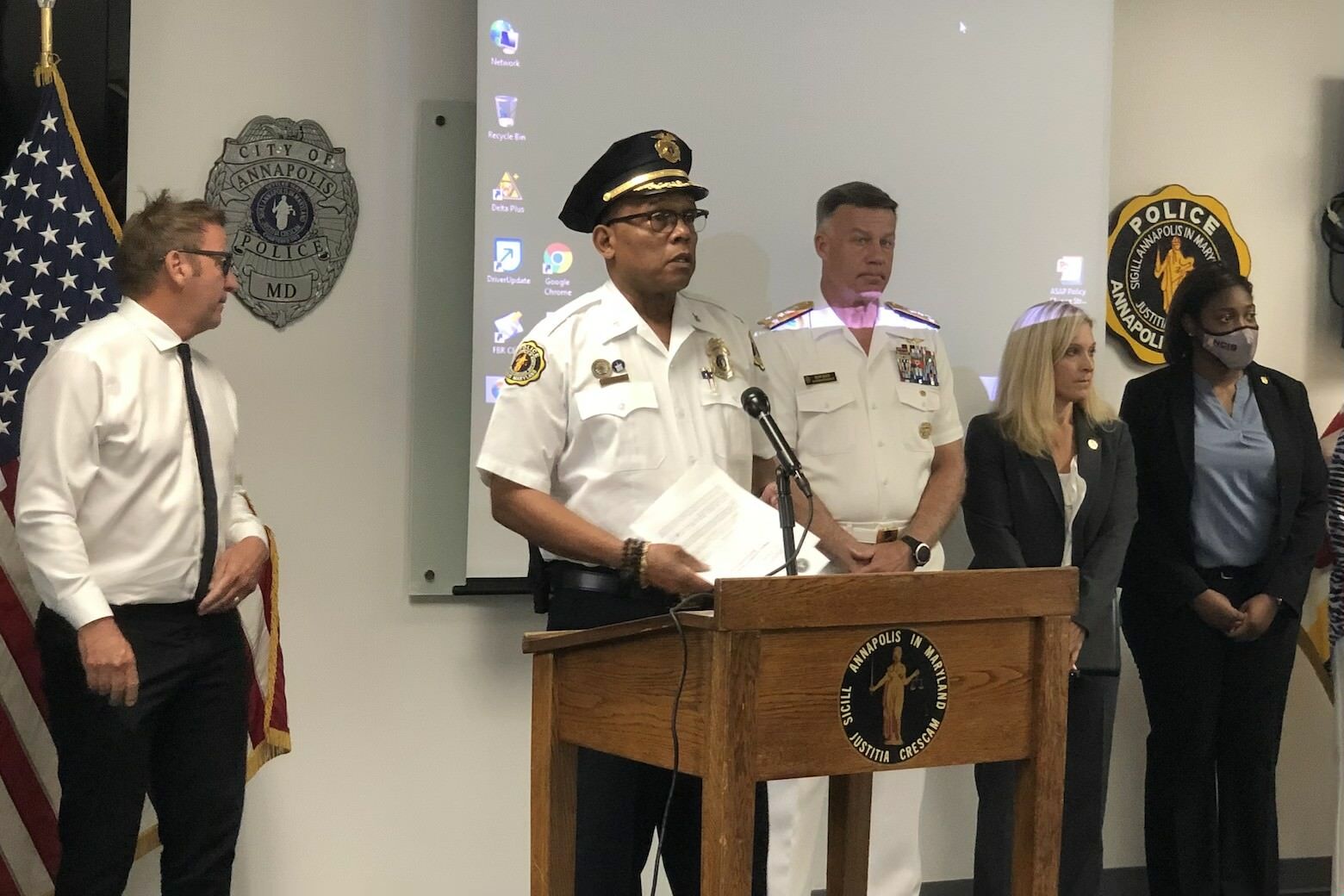
An Annapolis man has been charged with killing a U.S. Naval Academy midshipman’s mother, officials said Wednesday.
“He had an ankle bracelet on and he was on home detention, and he cut the ankle bracelet off and he absconded from his home and became a fugitive,” said Annapolis Police Chief Ed Jackson during a news conference.
Angelo Harrod, 29, of Annapolis, has been charged with first- and second-degree murder, two counts of attempted first- and second-degree murder, involuntary manslaughter, manslaughter, the use of a firearm in a violent crime, loaded handgun on a person and reckless endangerment.
A stray bullet struck Michelle Cummings, 57, of Houston after midnight on June 29 as she sat on the patio of a hotel on West Street. She and her husband were in town for their son’s induction ceremony.
He was arrested on June 29 on unrelated charges from the outstanding warrant, Jackson said. He added that Harrod was found and taken into custody near the intersection of Forest Drive and Tyler Avenue in Annapolis.
Harrod is being held at the Jennifer Road Detention Center without bond.
“What should have been just a fantastic celebratory time for their family just turned for the worst due to somebody else’s recklessness,” Jackson said.
Michelle’s son, Leonard Cummings III, is a prospect for the school’s football team.
Authorities had offered a $57,000 reward for information in the case. The incident marked the third homicide in Annapolis this year.
“This is truly a senseless tragedy,” said Annapolis Mayor Gavin Buckley. “We have to get away from more guns, more guns, and more guns.”
Buckley said that the funeral for Cummings will be held Saturday.