Coronavirus diary: Under quarantine at home and delivering the news

I’m Will Vitka, digital editor for WTOP.com. I’ve been at home, working while in self-quarantine for longer than most. It’s been more than 40 days. And here’s what it’s been like.

We need caffeine

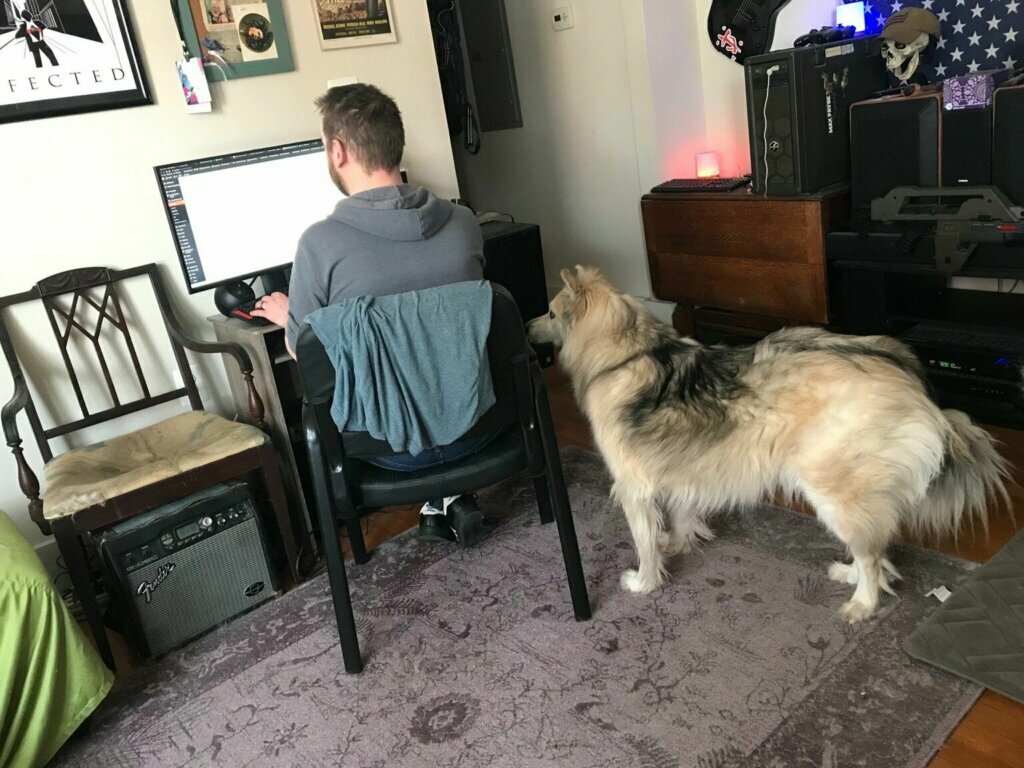
This is where I write the news. My dog Moby has become my editor. Unfortunately, most of her headline ideas involve squirrels. (WTOP/Will Vitka)
As a reporter, I crave caffeine. My wife Reem and I are in constant and dire need of it. When we run out, that’s when The Fear settles in. Now, The Fear is different than the exhaustion I’ve mentioned. The Fear is kind of the next step. An escalation. Because on top of exhaustion, we have to consider leaving the apartment to acquire caffeine — which, as far as Reem and I can tell, is critical to doing our jobs. No, we haven’t considered living without it. The world is enough of a nightmare hellscape as it is. Why bother trying to survive without caffeine?
Me, going to find eggs or coffee on any given day. (Courtesy Warner Bros.)
A quick example of Reem and me without caffeine, plus more than 37 days staying home: She made pancakes in a pot the other morning. We have perfectly good pans. She decided to use a pot. When I pointed this out, she just giggled and cackled in a “Hahaha, I swear I’m not a serial killer” way. One of the people I think about a lot, and talk to over Discord as often as is possible alongside my brother and our gaming buddies — in an attempt to maintain our sanity, though results are dubious at best — is my friend Chris, who currently lives in habilitation due to cerebral palsy. His roommate recently tested positive for COVID-19. The only thing the habilitation center could do was put up a plastic barrier. As bad as things feel for many of us, just keep in mind that it’s a lot worse for others. And I’m not saying things will get worse but… things will get worse. Both for those in isolation and those not isolating. And I think that’s especially true when I see so many ignoring distancing and mask (face covering) guidelines. Being a reporter these days already feels like Kevin McCarthy at the end of the original “Invasion of the Body Snatchers”:

YouTube

To view this content referenced from YouTube, click here.

But, regardless, we need caffeine. That means running to the store, grabbing the goods and getting out of Dodge as fast as possible to keep working. Ever since the Centers for Disease Control and Prevention switched tracks and said people actually should be wearing some kind of cloth covering over their face, I don’t leave the apartment without a mask (one my mother-in-law made). And, man, when I get back, I scrub the hell out of my hands. It’s not merely an abundance of caution or paranoia. Coronavirus isn’t going away any time soon. So bundling up, even when it’s warm outside, is the only responsible thing to do.

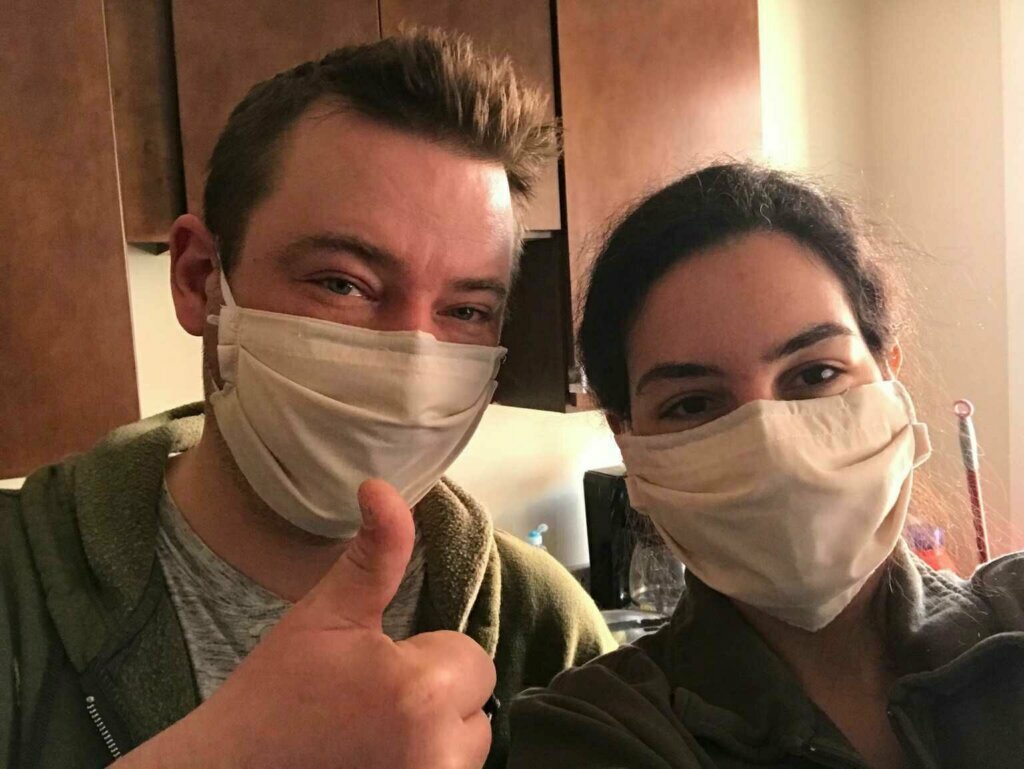
WTOP Digital Editor Will Vitka and his wife Reem are wearing homemade masks. Folks, wear a dang mask when you go outside. Seriously. (WTOP/Will Vitka)
If you want to see disgustingly irresponsible and gross as hell, check out the letter sent around my apartment building below.
A letter I recently received from management at my apartment building, because I guess things weren’t bad enough already. (WTOP/Will Vitka)
Emails were sent to residents, by management at the apartment building, asking them to “Refrain from flushing paper towels, wipes (even wipes designated as “flushable”) and other non-toilet paper items down the toilet.” I don’t think I flushed paper towels down the toilet even as an idiot child. Things are getting real, real weird out here folks. And it always feels like, even as a reporter, I’m only getting half the story.

YouTube

To view this content referenced from YouTube, click here.

Regardless, I aim to be responsible not just because I could potentially pass an infection onto Reem, or my District neighbors, but because if I get sick, I can’t do my job. I wouldn’t be able to edit or publish anything for WTOP.


More Coronavirus News


I’M NOT ALONE

I am not the only one trying to report amid coronavirus. The vast majority of WTOP’s staff is also working remotely. Alejandro Alvarez, another digital editor, has been self-quarantining because somebody close to him developed flulike symptoms. “I’ve been fortunate enough not to face financial difficulties so far but, about a week into self-isolation, I’d be lying if I said the mental burden isn’t becoming more obvious — and that’s from a social and professional perspective,” Alvarez said. “I’m a visual journalist first and foremost, so being locked indoors during what could become one of the stories that defines this decade is, in all honesty, frustrating. You’re relegated to watching the world through a screen.”

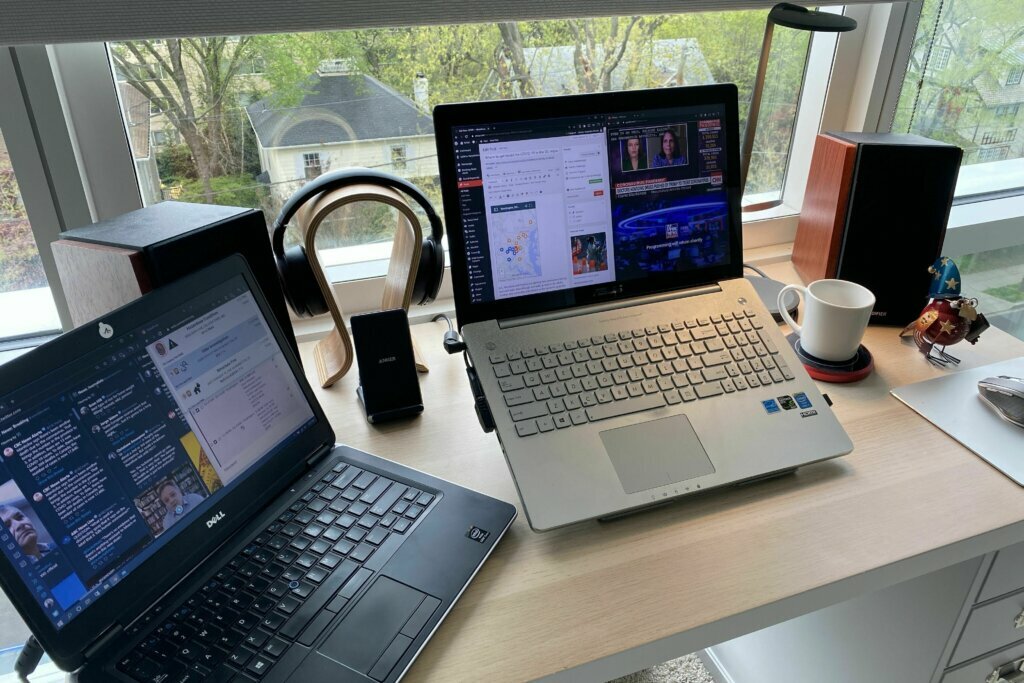
Alejandro Alvarez’s remote working setup. (WTOP/Alejandro Alvarez)
He said he stocked up early. “We’re doing all right with groceries. I’m an avid China watcher, so I was aware of the situation in Wuhan before most and took the opportunity to stock up on supplies before the run on the supermarkets,” Alvarez said. “Two months ago, I had a friend in Hong Kong ask me if I could ship her face masks and disinfectants when the virus first started to appear there and the panic buying began. Now, she’s the one sending me masks and supplies. How times have changed.”
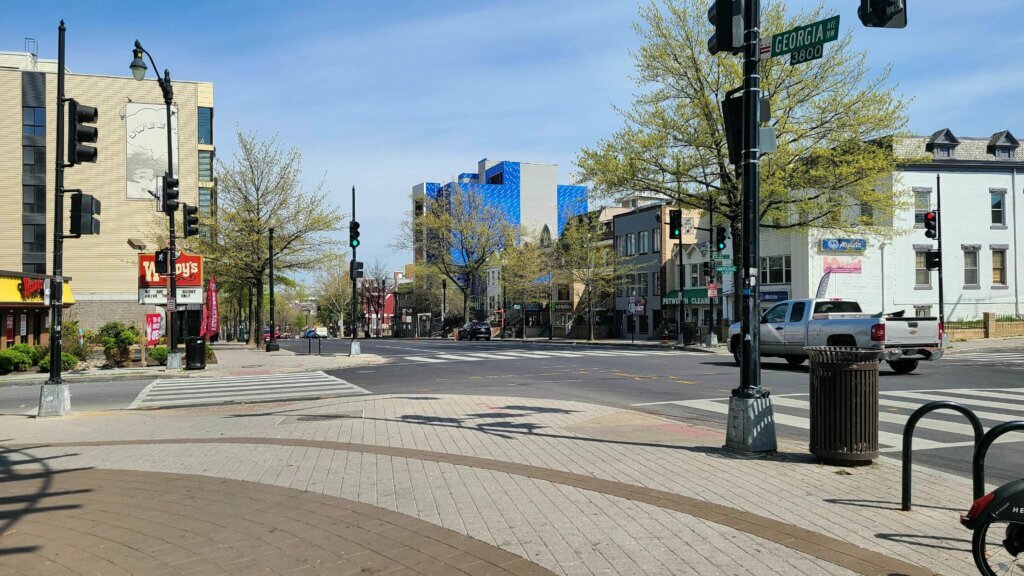
This is Georgia Avenue NW, outside the Safeway in Petworth. I’ve never seen it this empty. (WTOP/Will Vitka)
Here’s a look inside the Safeway in Petworth. Good luck, masked man. (WTOP/Will Vitka)
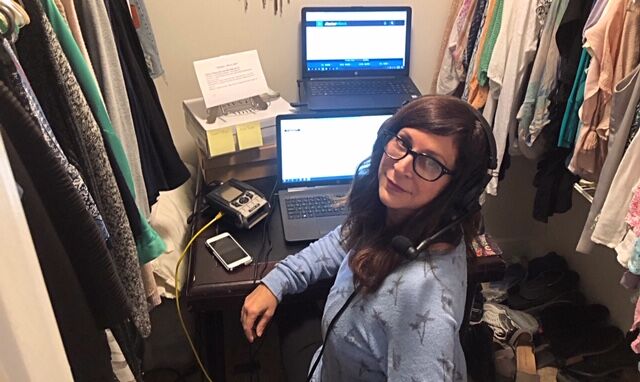
WTOP anchor Debra Feinstein is making it work too. She has been broadcasting from a makeshift studio in her closet. But it’s all still “a little eerie,” she said. “We are all used to the hustle/bustle/background noise of a working newsroom. It feels a little zombie-apocalyptic, and it is a stark reminder of how serious this is and how seriously we are taking it at WTOP,” Feinstein said.
WTOP anchor Debra Feinstein anchors from her closet. (WTOP/Debra Feinstein)
Neal Augenstein has been a staple of D.C. radio for decades. He still gets the news out from home.

X

To view this content from @AugensteinWTOP on X, click here.

(Just to tag onto Neal’s tweet above, my family canceled Easter. That’s unheard of. We streamed Easter instead — literally a sentence I never thought I’d write.)

“For the last couple of decades, it’s been possible to work from home, and for the past ten years I’ve been producing audio in the field on my iPhone. So, the tools were in place,” Augenstein said. “So now, covering news from home — it’s a challenge. Although news has always been about finding interesting stories and telling them — not physically going to a news conference. Those are now being streamed online, so we can cover them that way. But it’s taking some out-of-the-box thinking to get in touch with people, and have them provide good-quality audio. I don’t think I’d ever heard of Zoom before two weeks ago. Now, the video chat platform is being used by stir-crazy people and reporters trying to get good tape from newsmakers.” This is Traffic Reporter Dave Dildine’s setup at home.

X

To view this content from @DildineWTOP on X, click here.

Not everyone is working remotely. WTOP Director of News and Programming Julia Ziegler still heads into the office, day after day.

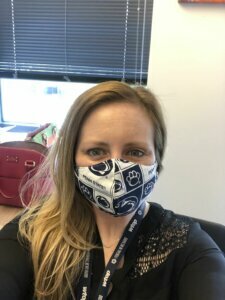
WTOP Director of News and Programming Julia Ziegler is in the newsroom, wearing a Penn State mask made by Kerry Walter —  a former WTOP employee (and part of the WTOP family for life). Walter used her closet of fabric to make masks for the WTOP team members still working in the office. (WTOP/Julia Ziegler)
“I would say the No. 1 priority is keeping people safe,” Ziegler said. “I want to make sure, on our team, people come first. So, for me, it’s making sure that no matter whether you’re someone who is working here in this news station or someone who has been working from home that you feel safe where you are.” Ziegler has gone so far as to clean radio studios herself. “I’m personally making sure that studios get clean,” she said. “Every day, I have gloves on, and I’m in the studios, wiping them down to make sure that they are completely disinfected before another anchor walks into that studio.” WTOP continues to adapt and shift tactics. “We’ve always been a very mobile newsroom,” Ziegler said. These are hard times. There’s no question about that. People are losing their jobs. People are struggling to make ends meet. To pay the bills. But if it’s any comfort, any at all, we’re going to keep bringing you the news. Also, I don’t mean to alarm anyone, but I just noticed I’m out of cheese. -Will Vitka, in isolation since March 11, signing off for now.  

YouTube

To view this content referenced from YouTube, click here.

Pete Buttigieg returns to first-in-the-nation South Carolina with a fresh appeal to Black voters

Orangeburg, South Carolina (CNN) — Pete Buttigieg has been to this small but historic city in South Carolina’s Midlands at least twice before, as an underdog presidential candidate in 2020 and then as the better-known transportation secretary under President Joe Biden in 2023.Now a private citizen eying a second White House bid, Buttigieg returned this weekend with renewed urgency, appealing to Black voters who have newly solidified influence in the 2028 nominating process and whom he failed to win over in his last presidential campaign.Buttigieg told party activists during a morning speech in Florence that Republicans were using redistricting as “the culmination of a generational project to dismantle Black representation.” He held a roundtable with students at a historically Black college where he discussed his idea of reparations for slavery. And during an evening speech to the storied NAACP branch here, he said President Donald Trump’s second term may feel all too familiar to activists who fought for civil rights in Orangeburg in the 1960s.“The mid-2020s does not represent our nation’s first experience with corruption and self-dealing, with bigotry and exclusion, with inequality and injustice, with undemocratic behavior or with political violence,” Buttigieg said, adding that prior struggles played out “not on some distant shore, but in places like Orangeburg.”With a midterm election looming where both parties are campaigning over the cost of living, Buttigieg chastised fellow Democrats whom he said prefer to prioritize economic concerns over tackling more fundamental questions about democracy. He argued that civil rights legends such as Martin Luther King Jr. and Rev. Jesse Jackson have shown that Americans “can — and we must — do both.”His trip to South Carolina, Buttigieg’s first since leaving the Biden administration, marked the beginning of a new phase of political maneuvering ahead of the next presidential election, with Buttigieg making a concerted effort to get in front of Black voters and demonstrating new bonafides from his transportation secretary tenure.It was also the first major visit by a potential 2028 candidate to the state since the Democratic National Committee voted on August 15 to keep it as the location for the first presidential primary in the nation, a nod to the political power of its large Black electorate.Buttigieg brushed off a question about his 2028 plans after his speech in Florence, telling reporters he is “totally focused on 2026.” But there were ample reminders of speculation about his next move on Saturday, including a scattering of homemade signs reading “PETE” and “2028” that sprung up when he took the stage. Surveying the enthusiastic crowd, he observed he should “come here more often.”One fan, 64-year-old retiree Karen Ench, wore a “Pete Buttigieg 2028” shirt to the speech. Contemplating his 2028 ambitions afterward, she said she thought he was “really taking it much more serious” and focusing on areas of improvement from 2020.A 2028 bid would undoubtedly start with higher expectations for the onetime mayor of South Bend, Indiana, compared to his first run.“The Pete Buttigieg of 2020 is not the Pete Buttigieg of 2026,” said Marlon Kimpson, a Black former state senator who backed Biden in the 2020 primary. “He has name recognition, he’s no longer introducing himself. I think people generally like Pete, and that’s a big deal in an open race because he starts out at a plus. But as we look at his economic agenda, just for the average South Carolinian, with emphasis on the African American community … and the political infrastructure he has deployed in our state, there will be questions with respect to those issues.”Buttigieg’s 2020 campaign, despite winning the Iowa caucuses with a much Whiter demographic, came to an end in South Carolina, dogged by his weaknesses with Black voters. After powerful South Carolina Rep. Jim Clyburn endorsed Biden and gave his flagging bid a shot of momentum that ultimately propelled him to the presidency, Buttigieg finished fourth in the Palmetto State and dropped out a day later.Biden received 61% support from Black voters in South Carolina, while Buttigieg got 3%, according to exit polls.Colleen Condon, a Charleston lawyer and longtime party activist who backed Buttigieg in 2020, said that “2020 is so hard to compare against” due to the unique circumstances of Clyburn’s support for Biden. Now, Condon, who is White, said, Democrats are “anxious for someone young and energetic” and noted Buttigieg would bring more experience to the 2028 race.“He has done a lot of work in the last eight years, (including) as secretary of transportation, in showing his ability to work on the federal level,” Condon said.‘What he’s actually done’In interviews across the state on Saturday, Black Democrats agreed Buttigieg’s experience as transportation secretary has distinguished him since he last sought their support. He played a high-profile role in promoting Biden’s bipartisan infrastructure law, visiting communities small and large across the country to announce funding for long-awaited projects.In Florence, Mattie Thomas, a member of the South Carolina Democratic Party executive committee, said she did not know about his time as mayor but now she sees him as “one of our best transportation secretaries.”“I think he’ll fare extremely well this go around because people, they’ve seen what he’s actually done,” Sandra Burgess Glover, a retired educator, said in Orangeburg as Buttigieg mingled with the dinner crowd before his speech.Buttigieg was showered with praise at the dinner for his June 2023 announcement in the city with Clyburn of a $23 million federal grant to better connect Orangeburg’s two HBCUs to downtown. Orangeburg Mayor Michael Butler prompted a standing ovation for Buttigieg when he brought up the project, calling it “a long time coming.”Deloris Frazier, a member of the Orangeburg County Council, embraced Buttigieg as he worked the crowd before the dinner, telling him that she keeps a photo in her home of the two of them from that day in 2023. She told CNN afterward that she’d support Buttigieg for president if he ran, joking that she would take the photo and “just blow it up and make it bigger.”Earlier Saturday, Buttigieg visited one of Orangeburg’s HBCUs, Claflin University, and held an hourlong roundtable with about 20 students. The conversation topics ranged from artificial intelligence to reparations for slavery, which was a litmus test in the 2020 primary.Buttigieg said he still supported legislation to create a commission to study reparations. But he said he learned as transportation secretary that the federal government could take “reparative” steps sooner, pointing to his efforts to combat decades-old urban planning that led to highways cutting across Black neighborhoods.“I have a perspective on that that I didn’t have before when I didn’t have a chance to work on federal policy,” Buttigieg said.Usir Jackson, the president of the Student Government Association, said afterward he found Buttigieg “down to earth” and “authentic.”Buttigieg, who took notes at some points, appeared moved when the roundtable topic turned to young voters feeling disillusioned – and Jackson shared why he still makes sure to vote.“I do it to respect people who came before me,” Jackson said, “so I could vote.”Hurdles remain with Black votersFor all the praise of his record in the Biden administration, some of Buttigieg’s admirers acknowledge he needs it to translate into far more Black voter support than he saw in 2020.While the crowd he spoke to in Orangeburg was overwhelmingly Black, the audience that came to see him earlier in the day in Florence, at the state Democratic Party’s Spratt Issues Conference, was mostly White.State Rep. JA Moore was a crucial Black supporter for Buttigieg in 2020 in South Carolina, backing him after then-California Sen. Kamala Harris dropped out. Moore said in an interview that any potential 2028 candidate needs to focus less on tailoring a message to Black voters and more on developing a “cadence” of regularly reaching out to them where they are.“What we call it is the difference between a ‘come here’ and a ‘been here,’” Moore said. “I think one of the things people missed about Joe Biden – he was a ‘been here’ in the sense that he had been coming to South Carolina for over 40 years.”Some Black Democrats said he may continue to face hurdles in the state as a gay man, an issue that came up in 2020 as he reached out to socially conservative church congregations. “This is the Bible Belt,” Thomas said matter-of-factly.“Sometimes they want to categorize a candidate or individual because of their sexual preferences,” said Brenda Montgomery, a 67-year-old training specialist from Lake City who saw Buttigieg in Florence. “But for me, he is everyone. He represents everyone, and I really like him as a person because he is approachable.”Buttigieg, whose crowd in Florence was dotted with some small rainbow flags, does not go out of his way to talk about his sexual orientation. But on Saturday, he spoke regularly about his two children, who are mixed-race, that he adopted with his husband, Chasten, noting fatherhood is the biggest personal change he has experienced since 2020.It’s a life change that would be put to the test by another grueling presidential campaign, which South Carolina Democrats see as likelier than ever. While he mostly avoided talk of 2028, he said in Florence that he was excited about South Carolina’s first-in-the-nation status and how it would spotlight the state’s diversity.Buttigieg has fielded the 2028 speculation by becoming one of the most prolific endorsers in the midterms, with an eye on supporting Black Democrats and Democrats running in Republican-leaning territory. He kicked off his South Carolina trip on Friday night by headlining a fundraiser in Charleston for Nancy Lacore, a retired Navy officer running for an open House seat in a district that Trump carried by 13 percentage points in 2024.Condon, the Democratic activist who helped host Buttigieg’s fundraiser for LaCore, said it was “extremely early, but I’m very inclined to” support Buttigieg again in 2028 if he runs.Moore said it was too early for endorsements but said he especially likes Buttigieg for at least one reason.Buttigieg “has the ability to learn and adapt,” Moore said. “I find that refreshing and appealing.”The-CNN-Wire™ & © 2026 Cable News Network, Inc., a Warner Bros. Discovery Company. All rights reserved.
Read Next Story