This story is part of WTOP’s 2026 Back to School coverage.
D.C. students made small gains in reading last year, but math results haven’t yet reached prepandemic levels, according to new citywide standardized test data released Thursday.
At a news briefing, District education officials shared results from the D.C. CAPE standardized test. The assessment is given to third through 12th grade students in English, language arts and mathematics in the spring. It assigns students a level between one and five. Students scoring Level 1 didn’t yet meet expectations, and Level 5 is defined as exceeding expectations. Scores of Level 4 or 5 are considered proficient and on grade level.
Across the city, there was a 2% increase in ELA proficiency and a 2.1% bump in math proficiency, compared with the 2025 results. About 39.6% of students were considered on grade level in reading in the spring, the highest proficiency the city has reported since 2015. About 28.5% were proficient in math.
Officials attribute several years of improving scores to investments in high-impact tutoring programs, teacher training materials and a focus on students adjusting during their first year of middle or high school. But while the city has surpassed its reading scores from before the pandemic, it hasn’t yet reached that level in math.
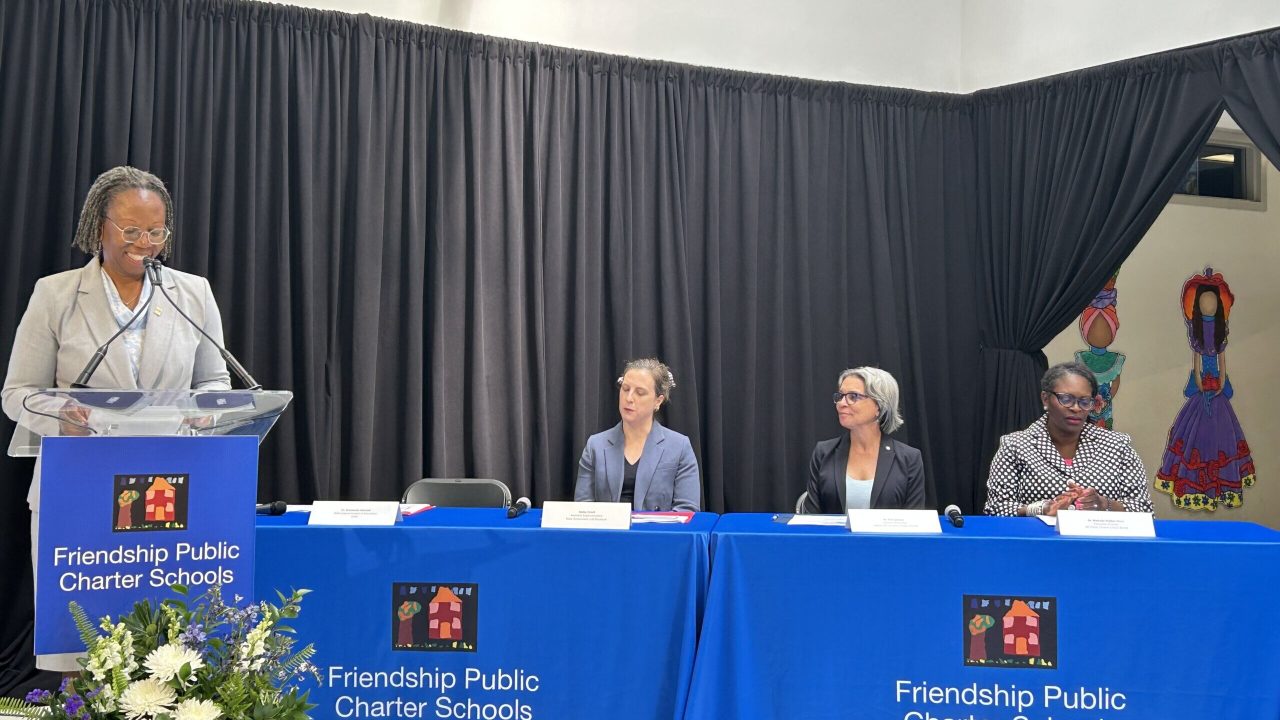
“We are encouraged, but not yet satisfied,” D.C.’s State Superintendent of Education Antoinette Mitchell said. “We have more work to do.”
Based on last year’s test data, eighth graders showed the greatest growth in reading, with a 5.7% increase in proficiency. Fourth grade scores fell 0.4% and high school scores fell 1% compared with 2025.
In math, meanwhile, third grade scores showed the most growth, increasing 6.8%. High school math scores fell 0.2% and sixth through eighth graders showed modest improvement.
Still, reading and math proficiency rates have increased every year since 2022.
“The pandemic was a huge disruption to our system, and teachers and students and families have been working very hard,” Mitchell said. “That is continuing to happen. I also want to say that our test scores, while very important, are not the only things that we have to talk about when it comes to postpandemic education.”
Over 4,700 students had access to high-impact tutoring in reading and math last year, the city said, emphasizing the value of the intervention that focuses on small-group or individual assistance.
In reading, students who participate in at least 20 hours of high-impact tutoring are better positioned to see “more favorable assessment score changes across grade bands,” according to city documents. Kids who have access to the tutoring programs are also more likely to attend class regularly.
But absenteeism and chronic truancy remain challenges, Mitchell said. The city has received a grant that involves a partnership for schools as it relates to attendance. It’s scheduled to begin in September. High schoolers have also been drawn to the city’s career and technical education offerings, Mitchell said.
Students with disabilities, those considered economically disadvantaged and English language learners all showed improvement in reading and math in 2026. Math proficiency increased across every ward in the city. Reading proficiency increased in every ward, except for Ward 2, where it fell 1.3%.
Among D.C. Public Schools specifically, interim Chancellor Kim Jackson said 86 schools improved their math proficiency rate and 64 improved reading proficiency in 2026. Jackson touted dyslexia screeners, subject materials and academies that help sixth and ninth graders get acclimated to new campuses.
D.C.’s Public Charter Schools reported a 2.6% boost in reading proficiency and a 1.5% spike in math proficiency.
Residency model helping Friendship Ideal Middle students take strides
Alise Webb was a resident teacher at Ideal Middle in Northwest D.C. in 2024-25, and then became an eighth grade reading teacher last year, enabling her to continue working with the same group of students.
When they were in seventh grade, the group was 42.9% proficient in reading. As eighth graders, that metric reached 76.9%. None of Webb’s students finished the year below grade level.
During the first year, “it was a really intense journey of becoming comfortable in front of a group of students,” Webb said.
But in October, it became clear to Webb that her students were understanding what they were reading and what she was saying. She was reading a writing prompt, and breaking down how to construct a thesis. The students told her they fully understood what she was saying.
“From there, I became more confident,” Webb said. “In turn, they started to become more confident as well.”
Often, Webb said she focuses on five students a week, evaluating their writing to better understand individual and group discrepancies. She was able to offer authentic feedback and grade them on a rubric, and she extended the exercise to having the class evaluate anonymous writing samples from one of their classmates.
The school offers math tutoring after school, and for Webb, “individualized tutoring is more so looking like intervention built into the actual school day,” she said.
Separately, fifth and sixth grade math teacher Everton Nelson has helped his students make significant strides, even as citywide data hasn’t yet reached prepandemic levels.
He followed the same kids across two academic years, and they gained 9.8 points in math. Nelson’s students experiencing homelessness reached 40% proficiency, which the city said is more than three times the city figure for that group.
“Once we get the students to buy in, then they feel self-worth,” Nelson said. “They think, ‘Oh yes, I can do it. I’m going to try.’ We allow math to become not just something we see on paper, not just abstract. We want them to see that math is real world, real life.”
Get breaking news and daily headlines delivered to your email inbox by signing up here.
© 2026 WTOP. All Rights Reserved. This website is not intended for users located within the European Economic Area.