More than 80,000 people registered for tickets to the 26th annual Library of Congress National Book Festival, a celebration of books, authors and storytelling in D.C. on Saturday.
The festival featured more than 80 authors, who signed books and participated in lectures and moderated conversations.
Among them was D.C. native and debut novelist Bsrat Mezghebe, who had attended the festival as a reader for years and was there for the first time as an author.
“I am thrilled. I am honored,” Mezghebe said.
Her debut novel, “I Hope You Find What You’re Looking For,” is fictional but draws on her life in the area.
“It’s definitely inspired by my experiences here in the D.C area as a D.C. native and by the kind of real-life characters that I was raised by,” she said.
Related stories
- DC-based book festival to feature film entertainers as well as authors
- WTOP Book Report: DC reporter Mimi Montgomery trades headlines for homicide in debut mystery ‘Murder Bites’
- WTOP Book Report: PBS NewsHour’s Geoff Bennett traces how black comedy changed America
Mezghebe said the festival’s atmosphere was also inspiring.
“It’s high, it’s infectious, it’s positive,” she said.
The sight of long lines for author talks, she said, offered an encouraging counterpoint to the idea that smartphones and social media are pulling people away from long-form storytelling.
“We’re all still here,” Mezghebe said. “We’re all still reading. We all still care about ideas and about spending time developing our ideas in long form and spending the time, not like rapid, quick, little sound bites.”
For Michael Feinstein, the festival was an opportunity to discuss a book that is part of a broader mission: preserving American cultural history.
Feinstein, a renowned interpreter of the American Popular Songbook, is the co-author of Liza Minnelli’s New York Times bestselling memoir, “Kids, Wait ‘Til You Hear This!” He said his work, whether onstage or on the page, is ultimately about preserving the past.
“Everything to me is about preservation and continuum,” Feinstein said.
That philosophy was shaped in part by his relationship with lyricist Ira Gershwin. Feinstein met Gershwin when he was 20 years old and spent six years working for him, eventually caring for his archive.
“Everything to me is about preservation and continuum,” Feinstein said, “because I was lucky enough to meet many people who are now legends when I was young.”
Among the artifacts he encountered were personal belongings that helped bring legendary composer George Gershwin, Ira’s late brother and songwriting partner, to life.
“He had his little black book with the names and numbers of all of his girlfriends in it, and his tie clip … when there’s physical objects, you feel a sense of that person,” Feinstein said.
That same commitment to preservation informed his work with Minnelli. After years of encouraging the reluctant performer to share her story in book form, the longtime friends spent years recording conversations that ultimately became her memoir.
“If you don’t write a book, your story, your perspective, your point of view will never be told,” Feinstein said he told her.
For Feinstein, the enduring power of books is their ability to carry those stories forward.
“The wonderful thing about a book is that it can last a long time,” he said.
A recent visit to Berlin included a stop at a site commemorating Nazi book burnings during World War II.
“And yet, these books survive,” Feinstein said. “Sometimes, there’s one surviving copy of something that has somehow made it past destruction.”
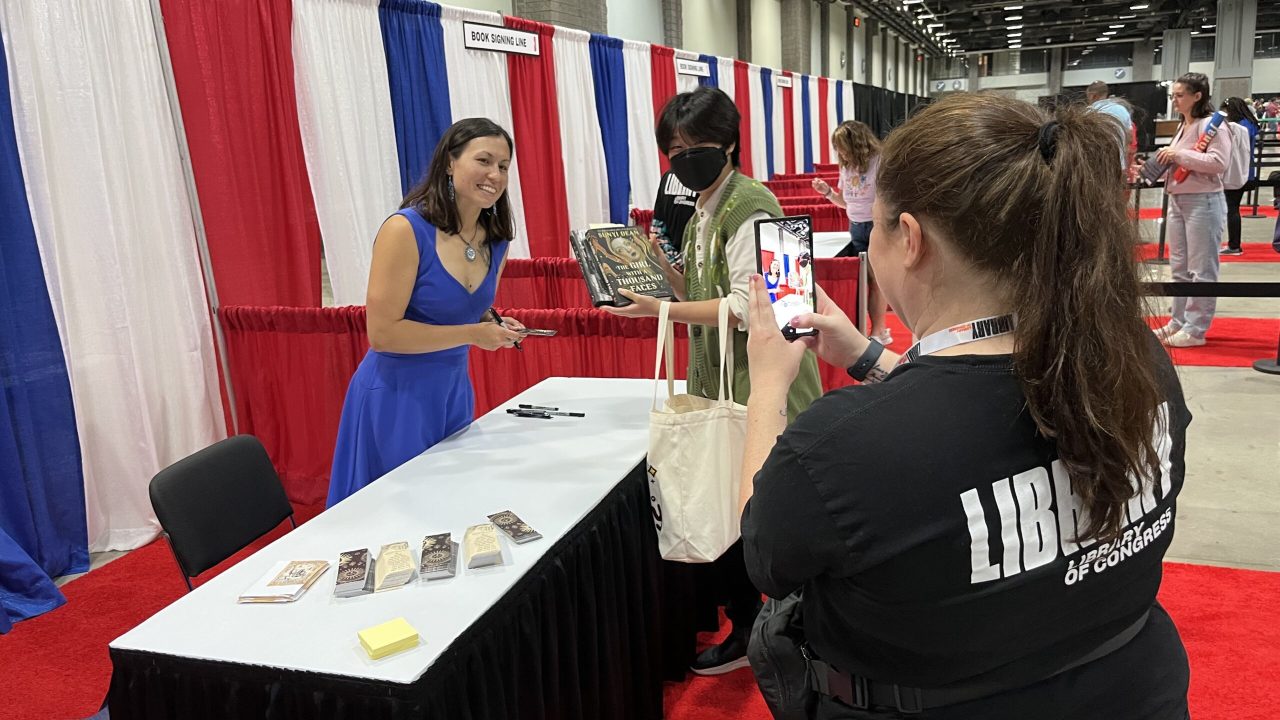
British author Sunyi Dean was attending the National Book Festival for the first time.
“I wish we had something like this in the UK,” said Dean, author of “The Girl With A Thousand Faces.”
Dean said the festival showed what can happen when a country makes a public celebration of literature.
“It’s eye-opening,” she said. “It’s like a view of what it could be if the right people cared about literature.”
Seeing tens of thousands of people gather around books was “incredible,” Dean said.
“I think it’s really heartening to see other people who love books and to remind that you’re part of a community, even if you don’t see them with you all the time,” she said.
For Mezghebe, that sense of community was also meaningful.
“So much of book writing is solitary, so it’s nice to be able to look people in the face, to sign their books, to maybe have a conversation about what they, you know, if they’ve read the book,” she said.