
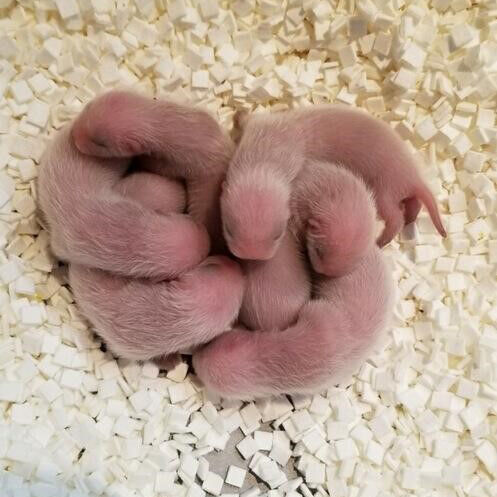
Fittingly, the first litter of black-footed ferret kits born this year at the Smithsonian institute came on Mother’s Day — and, for a limited time, the public is able to watch them grow online.
Two-year-old female Potpie gave birth to six kits at the Smithsonian Conservation Biology Institute in Front Royal, Virginia, last Sunday. Two-year-old Denver is the father, making this the second litter for Potpie and Denver.
The kits are blind and weigh less than 10 grams. The sexes have yet to be determined, as the animal care staff has left Potpie to bond with the kits, who will nurse for about a month before graduating to eating meat.
The institute said all six kits appear to be nursing, moving and vocalizing well.
Here are some things to look for in the kits:
- At about 3 weeks old, their signature mask-like markings around their eyes and dark markings on their feet will appear.
- At around 35 days old, they will open their eyes.
- At about 40 days old, they will begin venturing out of their den and exploring the tunnel systems in their enclosures that mimic the prairie dog burrows in which they live in the wild.
Virtual visitors can watch the family until then.
According to the Smithsonian institute, more than 960 ferrets have been born at SCBI, 200 of which have been reintroduced to the wild.
To view the kits, click here.


