
On a tour of a Metro station’s train control room, General Manager and CEO of WMATA Randy Clarke looked around a room that seemed frozen in time, surrounded by equipment older than him.
“We are currently like an 8-track system … we want to move to streaming,” Clarke said, comparing Metro’s technological advancement to audio. “The reality is we’ve got some antennas up, trying to get local channels.”
Clarke noted that the trains are still safe, but the technology it runs on is “not reliable long term.”
“We’ve got to adapt to the modern age. We got to use data center technology to get us to that high-reliability system,” he said.
Out of Metro’s 165 train control rooms, the one at Farragut North is one of the oldest.
“When you go in that room, you can see the old wiring, the old relays,” Clarke said.
While standing in the room inside a tunnel in the station, you can hear the trains roaring by. The equipment looks like, if it was not being used by Metro, it would be part of an old railcar display in a museum.
WMATA Chief Infrastructure Officer Theresa Impastato was also on the tour and said a lot of the equipment was so old, it was impossible to buy replacement parts.
“Any repairs that need to be made have to be made in-house,” Impastato said.
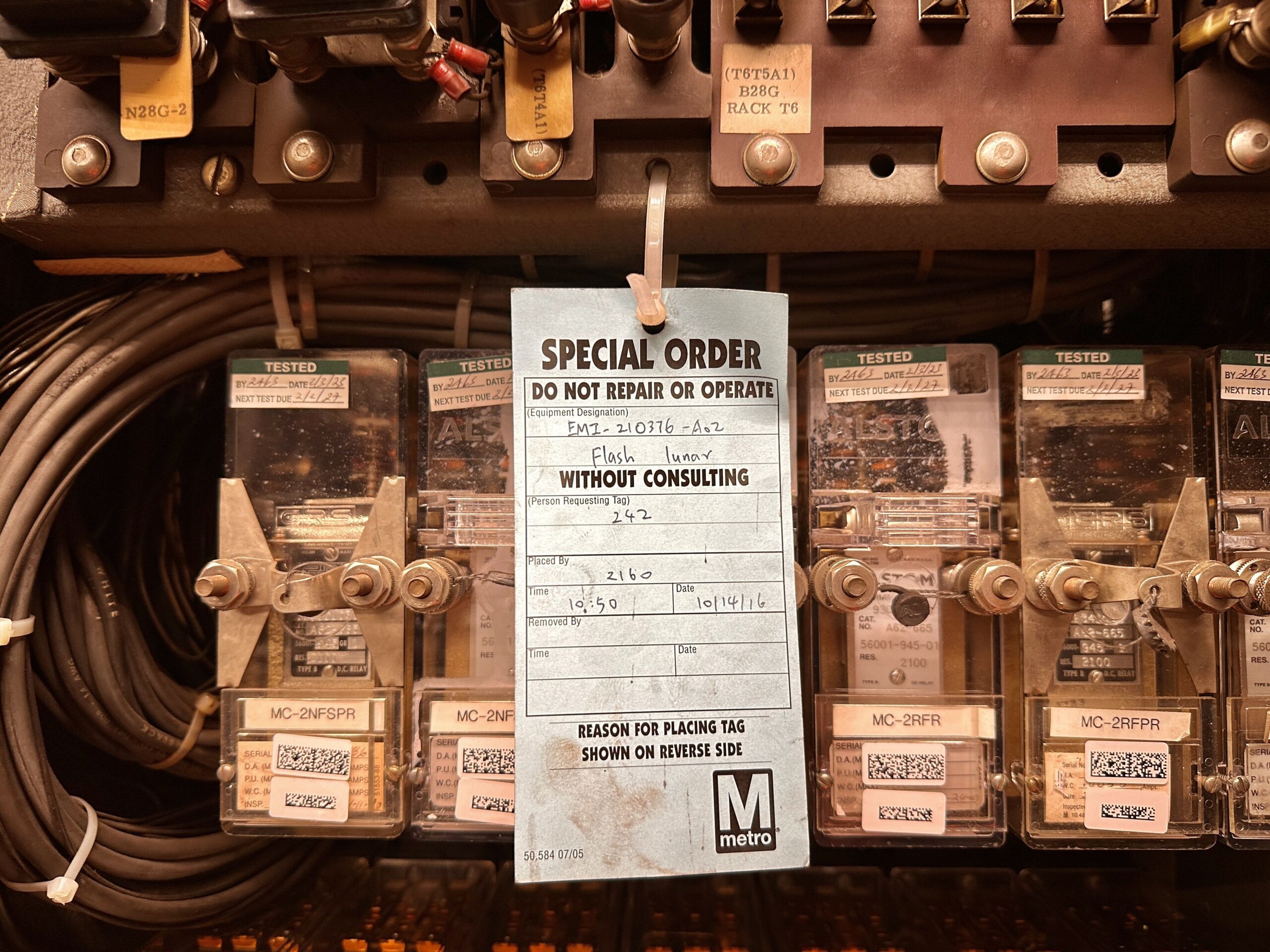
Metro employees remanufacture parts from old equipment
One of the items in the room that Impastato pointed to looked like something Dr. Rudy Wells would have used on “The Six Million Dollar Man.”
Most of the technology came from the original 1973 control room, Impastato said.
“The Red Line moves more people than National Airport and Dulles Airport combined in a day,” Clarke said. “And this is the equipment that we are moving our trains through every single day.”
Like a lot of us, Clarke said inflation has taken a toll on Metro financially.
“We got dedicated funding in 2018 for $500 million … but that $500 million wasn’t indexed,” Clarke said. “So that $500 million is not worth $500 million today. In five more years, it will be worth even less.”
Clarke said the indexing would ensure that Metro’s funding automatically increases along with cost of living.
While he stressed that the older equipment is not unsafe, he doesn’t think it’s wise to wait until it all breaks.
“We’re trying to be very proactive, being good stewards of the public money to say, ‘Let’s make sure that we’re ahead of critical failures,’” he said. “We need an infusion of capital dollars to really do the whole system.”