
A company affiliated with Virginia Tech has invented a new tire testing material that replicates real asphalt.
Most tire testing is done on a flat-trac machine, in which a metal belt spins underneath a tire secured to the testing machine, said Alex O’Neill, product and technical solutions manager with Virginia Tech’s Global Center for Automotive Performance Simulation.
The indoor testing process allows for a more controlled environment — without variables like temperature tainting the data. But there’s a cost — the tires can’t be tested on the same asphalt they drive on.
“Typically, we test on this special rig which uses sandpaper as its surface — the same sandpaper you’d use to smooth out some woodwork,” he said. “What we typically find when we test on sandpaper is a higher grip level than reality.”
O’Neill and his colleagues have invented a new, more realistic test surface.
“Asphaltant is made up of real aggregates, real stones, to have a surface which much better represents what everybody drives on outside,” said O’Neill.
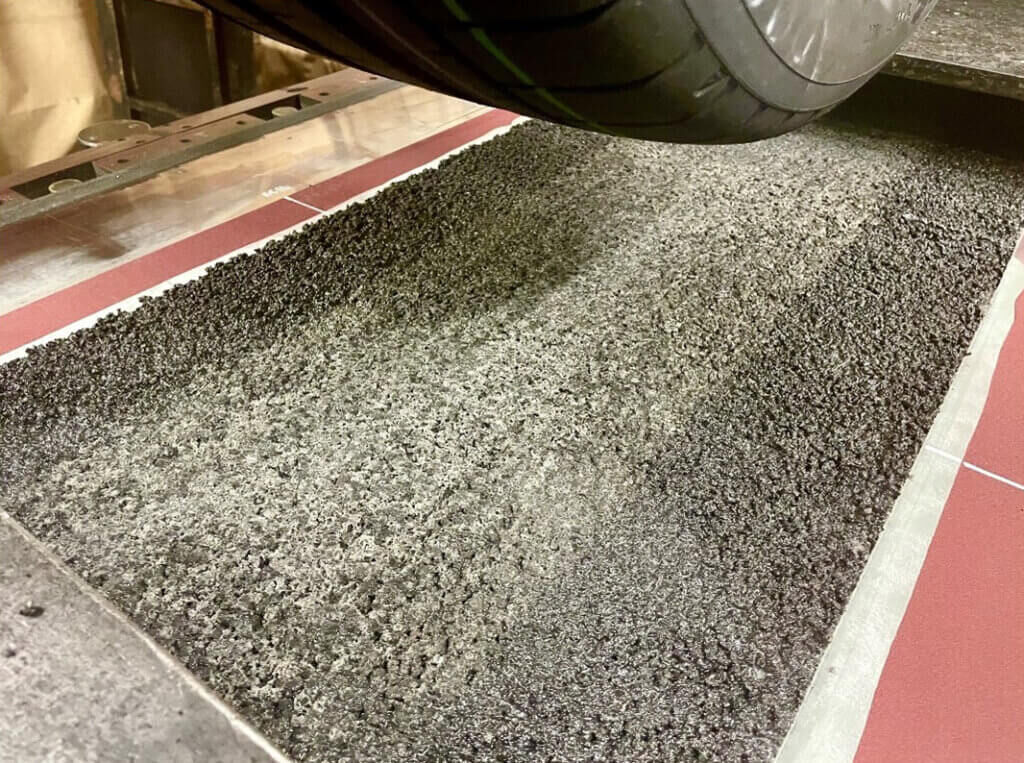
Asked to elaborate on what goes into Asphaltant: “I can’t say too much about the specific recipe. We have used real stones of various sizes. We have played with this recipe for a long time to get the right balance between realism and durability.”
After the tires are tested in a laboratory, O’Neill’s team creates a mathematical model from that data, which then goes into a computer simulation.
“Imagine the best-ever Gran Turismo game you ever played,” O’Neill said. “These simulations are very high fidelity, and that allows designers and engineers to change different design properties to maximize performance and safety.”
Given the Global Center for Automotive Performance Simulation’s proximity to the Virginia International Raceway in Alton, Virginia, it has been used evaluate tires for motorsports organizations.
“Everyone from government agencies, to original equipment manufacturers, to regular car manufacturers, to Formula 1 teams need more realistic tire models, and this is what we’re hoping to bring with this new product,” O’Neill said.