
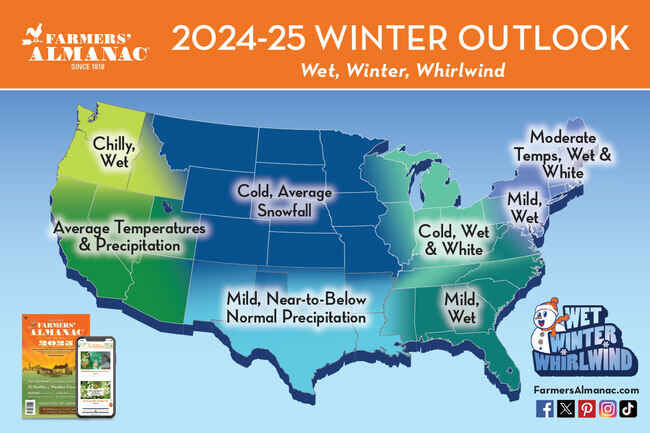
A cold front Monday night brought a chill into the air Tuesday morning, and if that has you thinking about winter, don’t get your hopes up too soon. The Farmers’ Almanac does not expect much snow across the D.C. area this year.
“In your area, we’re seeing kind of a mild, wet winter. So the temperatures won’t be too cold, but we do see a lot of wetness,” said Sandi Duncan, editor of the Farmers’ Almanac.
Duncan said that means a wet, but not very snowy, winter for the D.C. area, with a few possible exceptions.
“End of January, you might want to circle it, because we’re calling for very stormy activity, with some possibility of some snow in Maryland, so hopefully it will bring it over for D.C.” she said.
Duncan said there’s another chance for some snow at the end of February. If you can’t wait until then, she said there should be snow nearby.
“In the mountains we’re calling for more white, so if you are a snow lover, you might want to head north,” she said.
What’s behind the expected slushy and less snowy winter for us?
Duncan pointed to La Nina, which cools the Pacific Ocean waters and delivers a lot of moisture.
“Normally, we used to have snowy, kind of cold, winters,” said Duncan. “Our outlook doesn’t think that the temperatures will be that cold.”
That means the D.C. area may get lots of slushy days.
“Let’s all hope there’s a little bit of snow, rather than just the wet mushy stuff,” she said.