
It is hard to believe that two years have elapsed since NASA first released images and findings from the James Webb Space Telescope.
To put it mildly, the JWST has been making astronomical discoveries in the solar system, galaxy and literally the whole universe over the past two years.
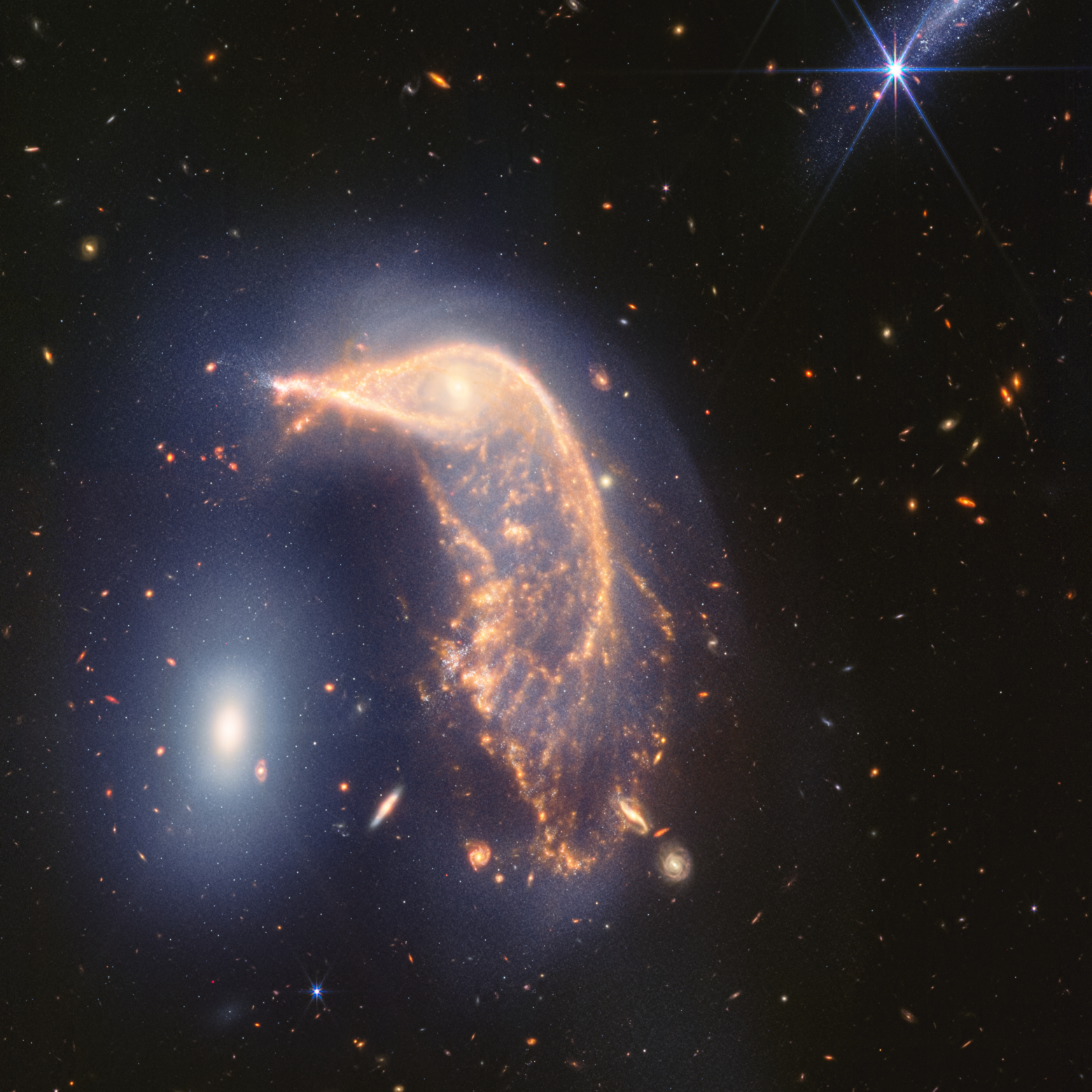
To commemorate this anniversary, NASA released a stunning new image at 10 a.m. Friday, dubbed the “Penguin and the Egg.” The image shows two galaxies that are interacting gravitationally to produce the spectacular view.
As described by NASA:
“Before their first approach, the Penguin held the shape of a spiral. Today, its galactic center gleams like an eye, its unwound arms now shaping a beak, head, backbone, and fanned-out tail.
Like all spiral galaxies, the Penguin is still very rich in gas and dust. The galaxies’ ‘dance’ gravitationally pulled on the Penguin’s thinner areas of gas and dust, causing them to crash in waves and form stars. Look for those areas in two places: what looks like a fish in its ‘beak’ and the ‘feathers’ in its ‘tail.’
Surrounding these newer stars is smokelike material that includes carbon-containing molecules, known as polycyclic aromatic hydrocarbons, which Webb is exceptional at detecting. Dust, seen as fainter, deeper orange arcs also swoops from its beak to tail feathers.
In contrast, the Egg’s compact shape remains largely unchanged. As an elliptical galaxy, it is filled with aging stars, and has a lot less gas and dust that can be pulled away to form new stars. If both were spiral galaxies, each would end the first ‘twist’ with new star formation and twirling curls, known as tidal tails.
Another reason for the Egg’s undisturbed appearance: These galaxies have approximately the same mass or heft, which is why the smaller-looking elliptical wasn’t consumed or distorted by the Penguin.
It is estimated that the Penguin and the Egg are about 100,000 light-years apart — quite close in astronomical terms. For context, the Milky Way galaxy and our nearest neighbor, the Andromeda Galaxy, are about 2.5 million light-years apart. They too will interact, but not for about 4 billion years.”
JWST is in great shape 1,000,000 miles from Earth and has enough fuel for about 20 years. That’s a lot of time to make discoveries and rewrite astronomy textbooks.
Follow my daily blog to keep up with the latest news in astronomy and space exploration. You can email me at skyguyinva@gmail.com.