
A 26-year-old tattoo artist from Takoma Park, Maryland, first picked up the needle during the COVID-19 pandemic. But a few short years later, Bibi Etienne has already grown her business to the point where she’s becoming more selective about the projects she takes on. “I just need a challenge,” Etienne said. “I need something to make me work for it.” Similar to countless others, she wasn’t working during the pandemic and said she found herself with extra time on her hands. While hanging out with a friend who had a tattoo machine, she tried it out for the first time. Etienne was immediately hooked. “I ended up like buying all my tattoo equipment, probably like a week after I did that first tattoo,” she said. 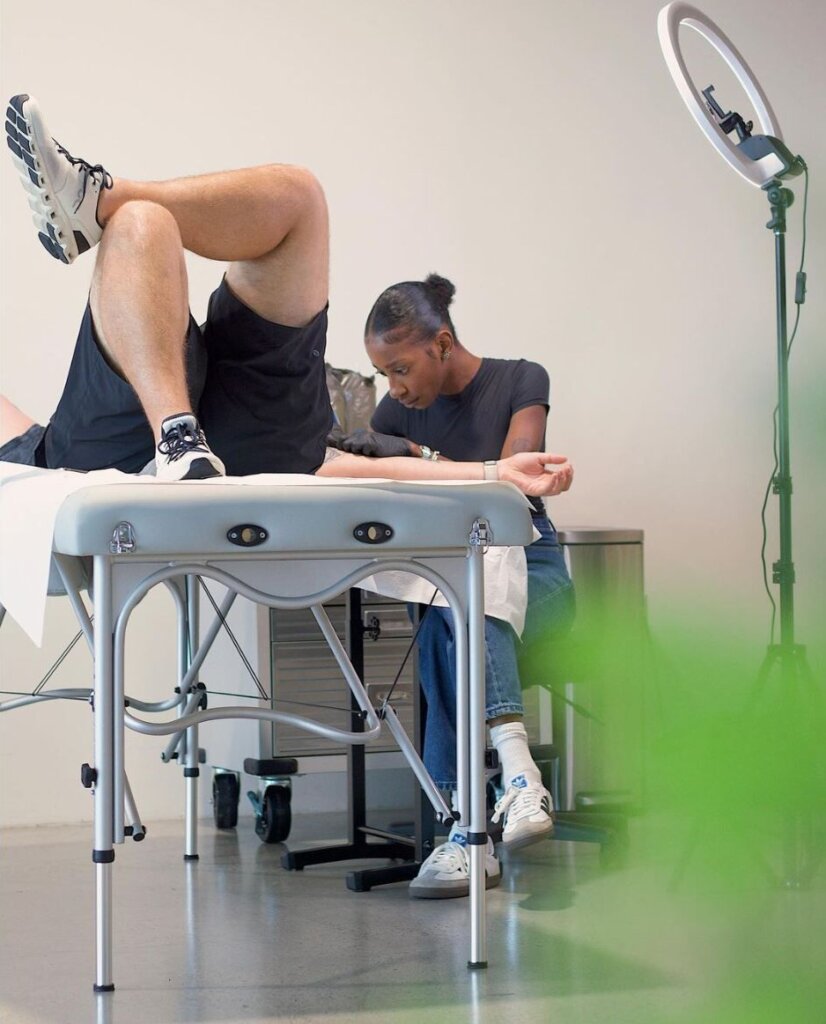
Inked Black history
Oftentimes, tattoos are expressions of identity. Etienne said as a Black business owner, she is honored to design tattoos that resonate with Black history. Some of those include a tender piece titled “Coils Instead of Curls” involving a kiss on the cheek between two cherubs.

To view this content referenced from Instagram, click here.
Another one of her tattoos showcases Adinkra symbols, which are symbols from Ghana that carry a variety of meanings, including strength and intelligence. One client asked Etienne to tattoo artwork that represents his pride in being African — an American Eagle holding a Nigerian flag. “I pride myself in being a tattoo artist, but more importantly, a Black artist,” she said. “I always want to support my fellow Black artists.” She encourages people to commit to supporting Black artists year-round, not just during Black History Month in February.
‘Tattoos can look like a work of art’
Some of Etienne’s portfolio include recreations of famous works of art, including a recreation of the “Automat” painting by Edward Hopper. The realist painter depicted a lone woman looking down at a cup of coffee.
To view this content referenced from Instagram, click here.
She has also recreated a Japanese woodblock print of a sailboat by Hiroshi Yoshida. Another one of her recreations is a photograph of dancer Isadora Duncan by Arnold Genthe. “Tattoos can look like a work of art,” she said. “They don’t necessarily have to be like, super heavy looking more traditional. So, I’m hoping to kind of open that door to a lot of people.” Tapping into that niche helped land her a gig at the National Museum of Women in the Arts, where she hosted a flash tattoo event in honor of the museum’s reopening in October. Though Etienne said she loves recreating art, she’s not married to any tattoo specialty. “I want to lean more into dog portraits. I would love to do architectural designs, like buildings,” she said. “But for now, I’m kind of just doing a little bit of everything. I don’t really want to stick to one bracket.” Ultimately, she said what she’s after is a challenge. That drive is something she said blossomed after experiencing adversity.
Grit
As a teenager, Etienne was diagnosed with Ewing sarcoma — cancer of the bone or soft tissues — in 2015. She went through nearly two years of chemotherapy. After finishing her treatment, she started a job working in property management but quit after a short time. “If I’m not happy with what I’m doing in life, then I’m just quitting and finding something else,” she said. That sentiment and grit motivated her to start her tattoo business — working out of a spare room in her parents’ basement before opening her studio in Takoma Park. She handles the business side of things, such as emails and marketing on Instagram, as well as designing the artwork for the tattoos. “I really love the idea of having a blank canvas and just creating so much out of that blank canvas,” she said. “Right now, my canvas is skin, before it was face with makeup. Before that it was a blank paper with some pen.” She’s currently booking appointments for March and April.