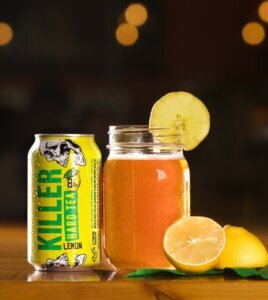
Frederick, Maryland-based Flying Dog Brewery has launched a new business beyond beer called Gonzo Drinks, and its first product is a hard tea.
Killer Hard Tea is available at retailers in Maryland now, and will be in D.C. stores., as well as New York, Pennsylvania, Ohio and West Virginia, in January.

Killer Hard Tea has an ABV of 8%, is lemon flavored, and is sold in 12-packs of 12-ounce cans. It is lightly carbonated.
Flying Dog, founded in 1990, currently ranks as the 35th-largest craft brewer in the country, based on sales volume, according to the Brewers Association.
A new distillery has opened in White Plains, Maryland, just south of Waldorf.
Copper Compass Craft Distilling Co. is co-owned by cousins Herb Banks, a 23-year Navy veteran, and April Toyer, a pediatric dentist.
The distillery produces rums, including a whiskey barrel rum and a coconut rum.
The distillery, at 4317 Charles Crossing Drive, includes a tasting room and hosts regular tours, with a brunch currently on its schedule.
There are roughly 30 distilleries operating in Maryland, most notably producing rye whiskeys. Pre-prohibition, Maryland was the fifth-largest alcohol producer in the country.