More households are renting rather than owning their home than any time in the past 55 years, and the makeup of renters versus owners in some neighborhoods in major metropolitan areas has radically changed.
Research done by RentCafe and based on U.S. Census Bureau data puts one D.C. ZIP code on its list of 101 ZIP codes that have seen a significant increase in renters.
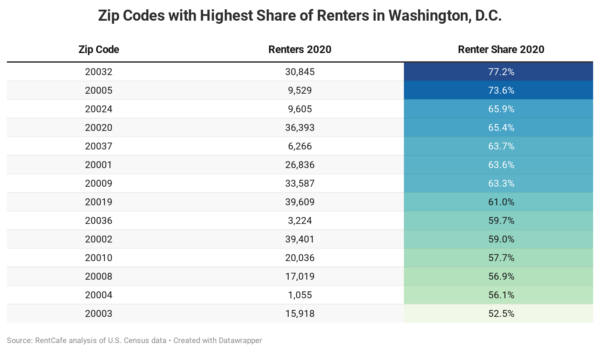
ZIP code 20003, in Capitol Hill, is now 52.5% renters, putting it at No. 15 nationally. The share of renters in 20003 has grown by 51.1% in the past decade. Almost 16,000 households in that ZIP code were renters as of 2020.
ZIP code 20032, in Congress Heights, has D.C.’s largest share of renters, at 77.2%. Congress Heights is followed by 20005, primarily Logan Circle, with 73.6% of households renting, and 20024, the Southwest Waterfront, at 65.9%.
The District on the whole has a majority of renters, at 54.7% versus 45.3% homeowners — figures that have not significantly change in the past decade. D.C. ended 2020 with 14 renter-majority ZIP codes.
Nationwide, a record 43.7 million U.S. households are rentals. RentCafe says ZIP codes with the fastest-growing renter populations are in downtown areas: Eight of the 20 neighborhoods that grew their renter populations by more than 80% in the past decade are in or near downtown.
D.C.’s Southwest Waterfront ranks in the top 20 for new apartment construction, with 2,901 units competed between 2017 and 2021, accounting for 8% of total rental units in D.C.
Below is RentCafe’s list of D.C. ZIP codes with the most renter households.