
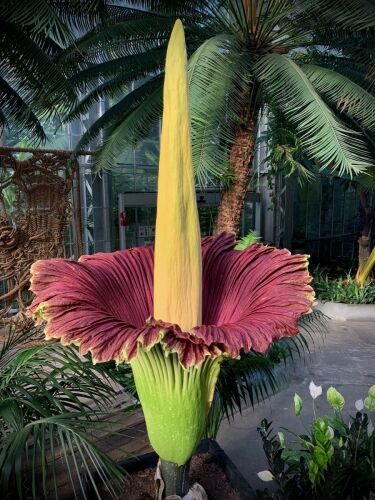
It’s described as smelling like rotting meat, which is how it got its name, “The Corpse Flower.”
The plant bloomed on Thursday evening at a height of just over 8 feet tall. The U.S. Botanic Garden said it’s the first bloom for the 9-year-old plant.
It can take seven to 10 years for the plant to gain enough energy to bloom, according to the Chicago Botanic Garden. Peak bloom is short lived, and lasts about 36 hours.
When it does bloom, the tall spadix, which looks like a yellow telephone pole, is wrapped by a spathe: a maroon colored, petal-like ring.
The Corpse Flower, or Amorphophallus titanum, is native to Indonesia, and is listed as endangered, with fewer than 1,000 estimated remaining in the wild.
It’s the largest unbranched inflorescence in the plant kingdom and can grow up to 12 feet.
Visitors can find it on display in the Garden Court of the Conservatory.
The garden displayed its first Corpse Flower bloom in 2003. And in 2017, more than 130,000 people came to see the bloom.