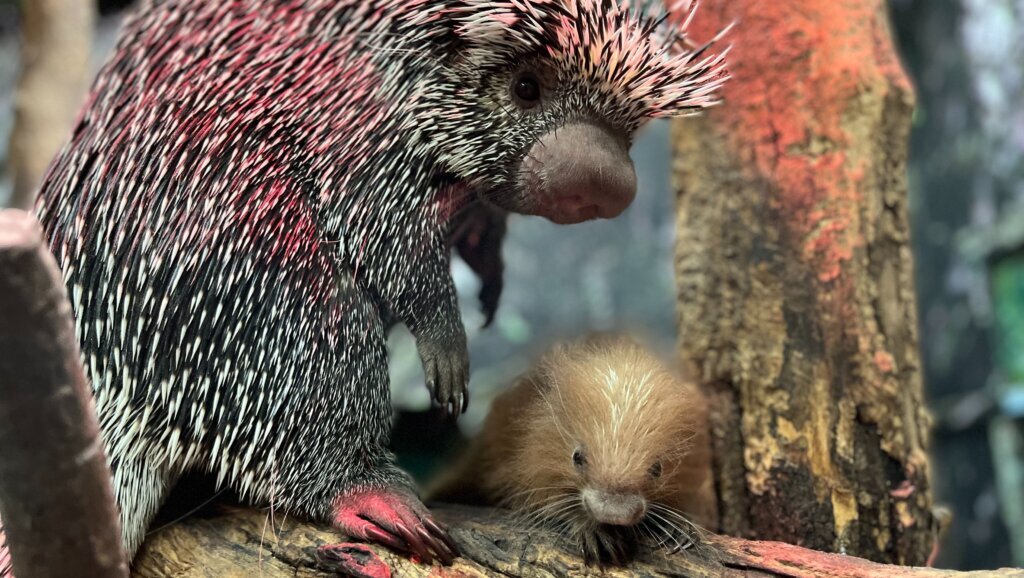
Guardians of the Galaxy, eat your heart out: Here’s a real “Peter Quill.” The Smithsonian National Zoo said Wednesday that prehensile-tailed porcupines Beatrix and Quillbur had their second baby overnight between Jan. 3 and Jan. 4. “All are doing well!” the zoo said in a tweet. “Our team looks forward to seeing if the newborn will take after mom, who is easy-going, or be more active + curious like dad!” Prehensile-tailed porcupines Beatrix and Quillbur at the National Zoo recently welcomed their second porcupette in early January. (Courtesy National Zoo) According to the National Zoo, prehensile-tailed porcupines, also called coendous, are one of 12 species of New World porcupines. They are native to South America, where they live in trees and eat fruits. It could take up to six months to determine a prehensile-tailed porcupine’s sex because its sexual organs are internal, according to the zoo. So, instead, National Zoo scientists can analyze DNA extracted from a quill. Get the baby names ready. We’re still voting for “Peter Quill.”
To view this content referenced from YouTube, click here.
The Mediterranean’s warming waters are drawing hundreds of invasive species
ROME (AP) — The Mediterranean of our ancestors is no more.
Scientists say climate change, caused mainly by burning oil, coal and gas, is making the Mediterranean Sea hotter, bringing hundreds of new and invasive fish species that decimate indigenous populations.
As biodiversity diminishes, coastal communities will struggle to make ends meet in the ways they’ve known for generations.
“The Mediterranean of our grandfathers, of our elders, and of the Greeks, of ancient Greece is lost forever. So many of those changes are irreversible,” said Ernesto Azzuro, a marine biologist with the Italian National Research Council's Institute for Marine Biological Resources and Biotechnology.