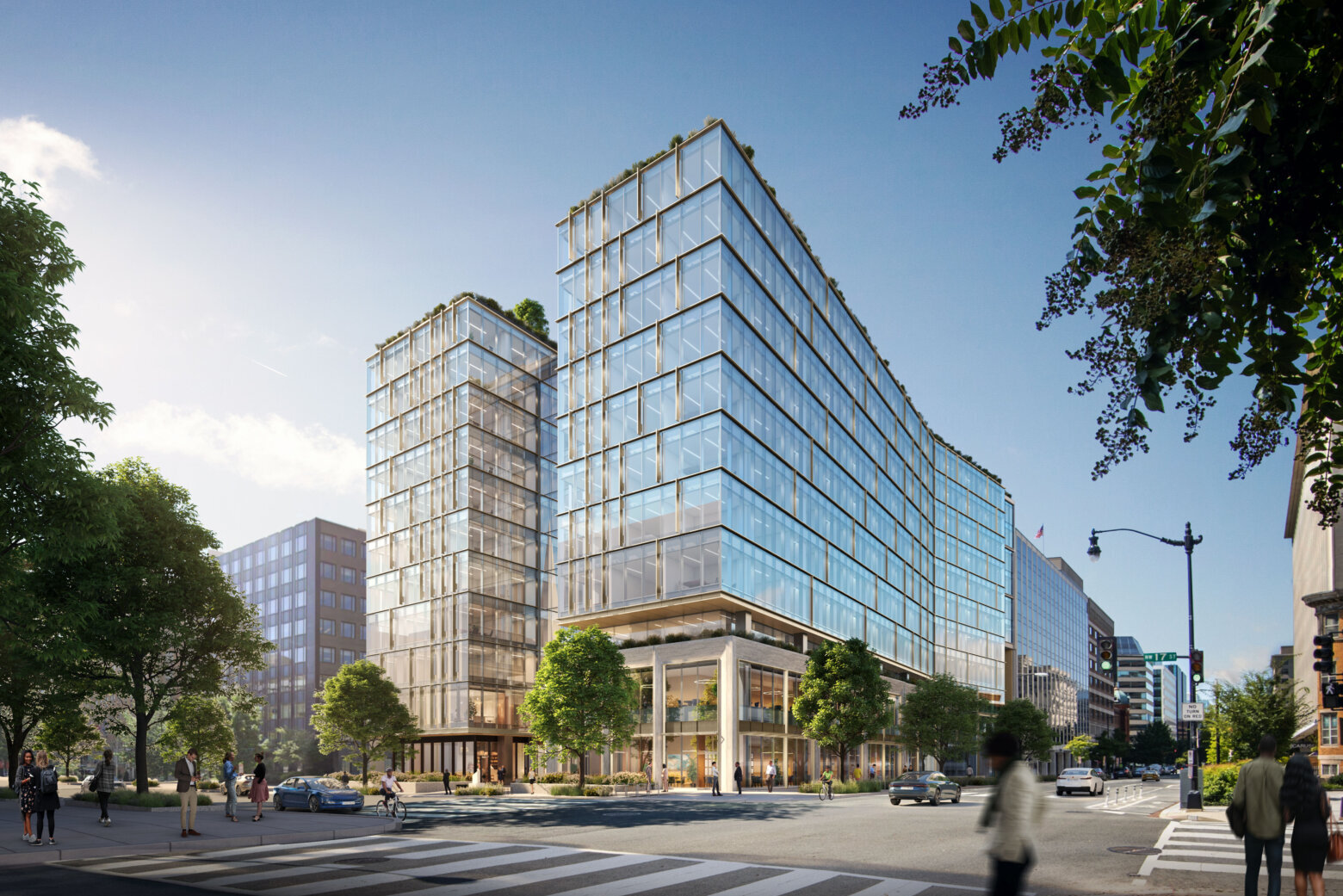
At a time when D.C. office vacancy rates are at historic highs, developer Skanska broke ground this week on a new office building downtown — in part because it already has a big tenant.
The building at 1700 M St., NW, about halfway between Dupont Circle and the White House, is called 17xM, and is among the first SmartScore certified developments in North America.
SmartScore certification identifies smart buildings that also drive cost efficiency, meet high standards of sustainability and are future-proof, or built with future needs in mind.
Others under development in North America that have received that certification are in New York, Boston, Houston, Chicago and Toronto.
Globally, 44 building developments are SmartScore certified. The SmartScore certification program was launched in April.
Skanska is also targeting LEED Gold, Fitwel and WireScore certifications.
Law firm Gibson, Dunn & Crutcher LLP has signed a lease for more than half of the 240,000-square-foot, 11-story building.
17xM is expected to be completed in 2024.
The building will include features for office worker wellness, conference and event spaces, a rooftop deck and lower-level terrace.
The location is one of the last remaining ground-up construction sites in Northwest D.C. The building is designed by Kohn Pedersen Fox.
17xM is one of several projects Skanska currently has in development.
Its others are at 3901 N. Fairfax Drive in Ballston, a nine-story, 230,000-square-foot building, and The Heming, a 28-story, 410-unit luxury apartment building in Tysons.
Skanska will also break ground this month on a 13-story apartment building in D.C.’s NoMa, scheduled to be completed in 2024.