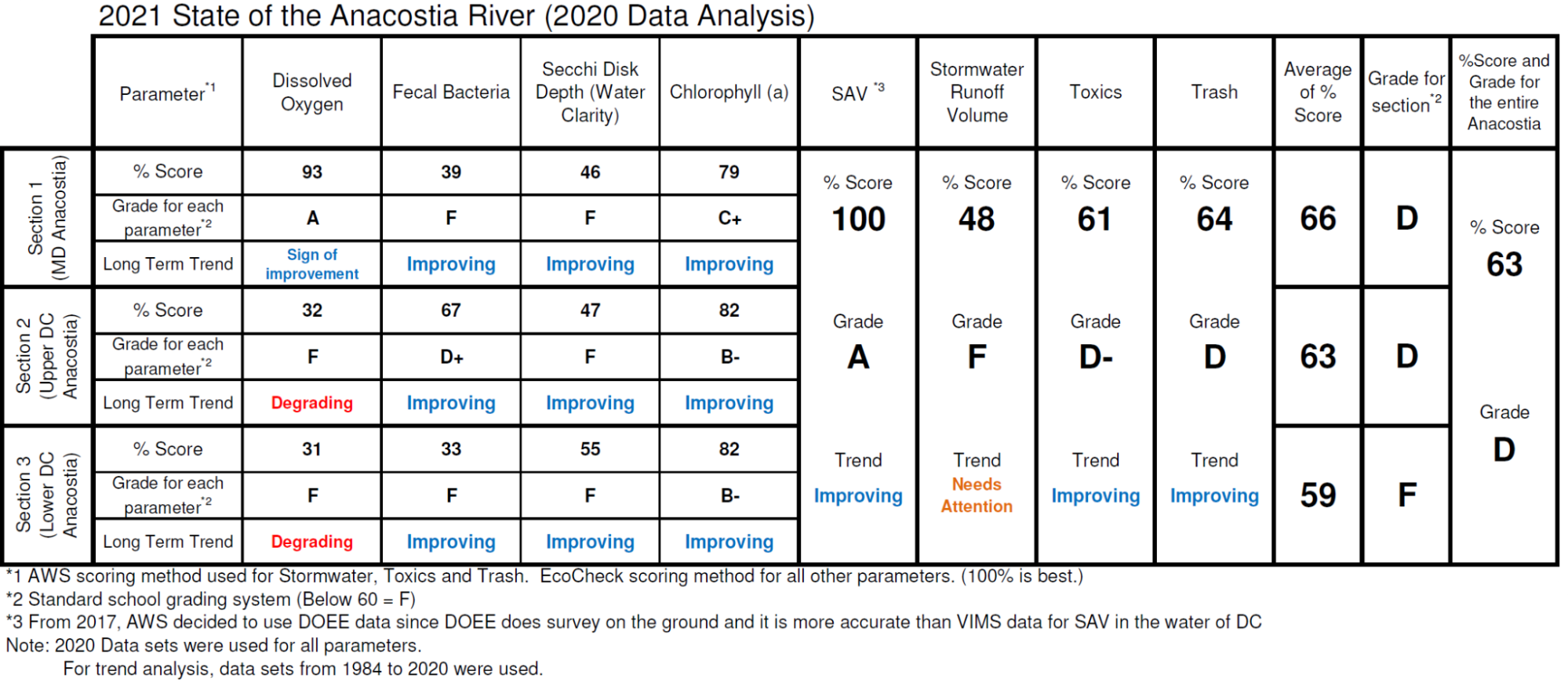
The ecological conditions of the Anacostia River are improving, according to this year’s report from the Anacostia Watershed Society, but barely. The overall water quality got a passing grade for the third time in a row — albeit, earning a D grade. So don’t plan to go swimming anytime soon. Here’s how the Anacostia River scored. Click on the graphic to enlarge. With a baseline of anything over 60 being “passing,” the only part of the river that passed the “fecal bacteria” — poop water — section was upper D.C. with 67. Toxins continue to be a problem, though this year did mark the first time the river got a passing grade for that. “Thanks to significant efforts by the federal and District governments to address toxics at the river bottom, the score for Toxics Remediation received its first passing grade,” the report said. “There are many toxic chemicals in the river such as pharmaceuticals, PCB, PAH, pesticide, herbicide, and heavy metals, to name a few.” River critters seem to be doing better, at least, including mussels. “In 2018 we began our #MusselPower program to propagate mussels in the Anacostia River,” the report said. “Juvenile mussels produced by our partners at a hatchery at the Virginia Fisheries and Aquatic Wildlife Center were deployed for a year in floating baskets at eight locations in the Anacostia River.” “This program continues today, and as of May 2021, the Anacostia Watershed Society has returned 19,000 native freshwater mussels to the ecosystem, and they will filter 69 million gallons a year, the equivalent of 106 Olympic-size swimming pools annually.” Local otters seem to think the Anacostia is getting a bit healthier, too. Here’s hoping they safely make their way to some Maryland crabs.
A North American river otter is a rare sight around the National Mall. 🦦Once eliminated from the area, the species is on the road to recovery. Though they are cute & playful, you otter remember that they are wild animals & never get too close. #WashingtonDCpic.twitter.com/NpeeAUMGsl
— National Mall NPS (@NationalMallNPS) May 24, 2021
Filling out the Free Application for Federal Student Aid, or FAFSA, which opens by Dec. 31, is one of the most important steps students and their families can take to pay for college. Some states now make completing the FAFSA a high school graduation requirement.
The U.S. Department of Education awarded about $111.6 billion in federal grants, loans and work-study funds in fiscal year 2022, according to the most recent Federal Student Aid annual report. Those federal funds will assist roughly 9.8 million students in completing their education.