
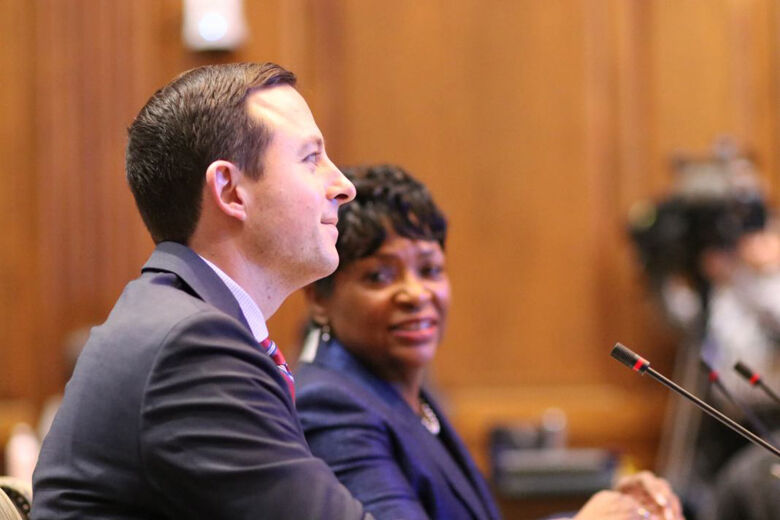
Signing the unanimous conference committee report on HB670! THANK YOU @LukeClippinger @SpeakerAJones for your leadership on #PoliceReform & #PoliceAccountability! Thank you @DavidMoon2014 for all of your thoughtful hard work! Such a proud moment! https://t.co/de7QYOm1UQ
— Vanessa Atterbeary (@VAtterbeary) April 7, 2021
But the celebration was hard-fought. Following contentious, marathon voting sessions both in the Senate Judicial Proceedings Committee and on the chamber floor last week, House Judiciary Committee Chairman Luke H. Clippinger (D-Baltimore City) rejected more than a dozen Senate amendments to the speaker’s bill Friday and requested that members of both chambers meet to iron out their discrepancies in a conference committee. The Senate neglected to acknowledge the House’s request for a conference committee until Tuesday’s floor session, when Judicial Proceedings Committee Chairman William C. Smith Jr. (D-Montgomery), Sen. Jill P. Carter (D-Baltimore City) and Sen. Michael A. Jackson (D-Prince George’s) were appointed to negotiate the bill. Senate Minority Whip Michael J. Hough (R-Frederick), also a member of the Judicial Proceedings Committee, was designated as an observer. The House appointed Clippinger, Atterbeary (D-Howard) and Del. David Moon (D-Montgomery) as its conferees. House Majority Leader Nicholaus R. Kipke (R-Anne Arundel), who did not work on the House Workgroup to Address Police Accountability in Maryland and is not a member of the Judiciary Committee, served in an advisory capacity. The bill as amended by the House and Senate conferees hit the House floor just before 1 p.m. and passed following a brief break to allow Republicans to read the amendments. When the body reconvened, the debate was swift. Four Republicans — Dels. Lauren Arikan (R-Harford), Daniel L. Cox (R-Frederick), Susan W. Krebs (R-Carroll) and Gerald W. Clark (R-Calvert) — rose to raise last-minute objections, though all praised the hard work that went into the legislative package. “When we oppose this, please appreciate where we’re coming from,” Krebs said. “We love our police. We respect our police. And we have the lowest crime rate in Carroll County in the state of Maryland.” Atterbeary, who helped develop Jones’ police reform package and shepherded it through the legislative process, made one of the closing arguments. She began by addressing Krebs’ concerns, telling her colleagues that she has a close friend in Carroll County who is Black and has felt the sting of hardcore police tactics. “Because it doesn’t affect you — there are people in each and every jurisdiction in this state that will be affected,” Atterbeary said. The final argument was made by Kipke, who, in a surprising turn, spoke in the bill’s favor. He said he was speaking as an individual delegate, rather than as the Republican leader, someone with Black constituents who have an uneasy relationship with the police — “even though,” he joked, “[former Gov.] Martin O’Malley tried to redistrict every one of them out.” “I’ve spoken to some of you in leadership that I was losing sleep over public safety for my kids and for your kids,” Kipke told the chamber. “But I think what we’ve seen here is an appropriate middle-ground that’ll do some good, and I’ll sleep comfortably tonight.” Jones’ bill passed on a vote of 97-39. The only delegates to cross party lines were Kipke and Del. Brenda J. Thiam (R-Washington), who voted for the measure, and Del. Mary Ann Lisanti (D-Harford), who voted against it. ‘I voted for SB 71’ The amended HB 670 didn’t receive a warm welcome from Senate Republicans Wednesday, who were denied the opportunity to review the conference committee report outside of the floor session before casting their votes. Smith gave the chamber a quick rundown of the conference committee agreements, which include measures to:
- Alter the tort claims provisions to clarify that the civil liability cap applies to the violation of constitutional rights;
- Allow misconduct complaints to be filed with the police accountability boards established under the bill;
- Change the makeup of county charging committees to include only civilians;
- Establish that officers can have attorneys when appearing before charging committees only if they were compelled to appear;
- Strike the Senate amendment that would allow a disinterested attorney from sitting on trial boards;
- Require that police officers are provided a copy of their investigatory file at least 30 days prior to their trial board proceedings;
- Authorize police chiefs to fire officers who have been convicted of secondary assault; and Strike the provisions of the bill that would require officers to forfeit their pensions as a punitive measure.
“Mr. President, with all due respect, we need time to check this out,” Sen. Johnny Ray Salling (R-Baltimore County) asserted. “And we just heard the chairman … but there’s so much more detail to this and we need opportunity to really read this in detail.” Smith successfully urged the body to reject Republican pleas to delay consideration of Jones’ bill, which passed on a vote of 31-15. Sen. Katherine A. Klausmeier (D-Baltimore County), who opposed the bill, was the only lawmaker to break ranks with her party. But HB 670 wasn’t the only bill to receive pushback from Senate Republicans Wednesday. The Senate also cast its final votes on police reform originating in its chamber, most of which received harsh criticism from Republicans on the Judicial Proceedings Committee’s decision to concur with House amendments that condensed the package of nine, largely bipartisan bills down to just four pieces of legislation, including:
- SB 600, sponsored by Smith, which would set forth a process to independently investigate use of force incidents that result in death through an independent unit of the Attorney General’s office and adopted portions of SB 599 to prohibit law enforcement agencies from procuring weaponized vehicles and other surplus military equipment;
- SB 178, sponsored by Sen. Jill P. Carter (D-Baltimore City), which would alter the Maryland Public Information Act to allow certain officer misconduct records to be available for public inspection and adopted portions of HB 670 and SB 419 to regulate the execution of search warrants;
- SB 71, sponsored by Sen. Charles E. Sydnor III (D-Baltimore County), which would order police departments throughout Maryland to provide body-worn cameras for on-duty officers by 2025 and adopted measures from SB 74 to create an employee assistance mental health program and portions of HB 670 and SB 626 to implement a statewide use of force policy; and
- SB 786, sponsored by Sen. Cory V. McCray (D-Baltimore City), which would create a vehicle to re-establish local control of the Baltimore Police Department.
SB 600 passed on a vote of 31-16 and SB 178 on a vote of 31-17. McCray’s SB 786 was sent to the governor’s desk on a unanimous vote. Sydnor’s SB 71 received the most blowback. Republicans filibustered the bill for over three hours Wednesday before Senate Majority Leader Nancy J. King (D-Montgomery) filed cloture motion to limit the debate to 30 minutes — 15 for each side. Hough said he was happy that the debate had been limited.

“I think the members of this caucus are glad in [having] pushed to have that cloture vote because I want it to require a super-majority in order to do this,” he said. “So I could tell my constituents and the police officers back home I did everything I could to stop a bill that was written on the House floor yesterday with a standard that is not defined in Maryland law — not defined in case law — that would make them a criminal.” Around the debate’s 45-minute mark, Sen. Robert G. Cassilly (R-Harford), who was making his second argument in opposition to the bill, grew frustrated with Democrats who he insinuated were not listening to him. “For the folks listening at home, you have to recognize that there’s like half-a-dozen people on the floor now,” Cassilly said. “This is a really serious issue and this body takes this stuff seriously. I can tell because we’ve been all politics since this debate began, so we don’t really need to listen to anybody because we already have our marching orders.” Many arguments lobbed by Republicans Wednesday hinged upon party-line politics and the destruction of the Senate’s bipartisan bills. Sen. Christopher R. West (R-Baltimore County) told the body that he “enthusiastically” supported the reform package in its original form — so much so, that he put his name on it as co-sponsor. He said that House lawmakers never consulted the bill’s sponsors about changes to the bill, which he no longer supports. “I understand that at this stage there’s nothing I can do to take my name off of the bill as a co-sponsor,” West said as Republicans laughed. “This is a bill that I can’t possibly support, and I want to make this statement on the floor of the [Senate] so that posterity will know that I do not sponsor this bill.” Cassilly blamed the court of public opinion for pushing the bill so far from its original posture, saying that he saw the “end result of this entire police reform initiative” as a product of the “Twitterocracy, where the overriding goal is to appease the folks in the Twittersphere.” Perhaps a symptom of the public’s limited access to the legislature, advocates for and against police reform have been actively lobbying lawmakers over social media platforms this session. Republicans have been particularly critical of pro-reform advocates on Twitter. Cassilly called them an “angry mob.” “What the problem with the Twitterocracy is that the Twittersphere, folks, is not populated by a cross-section of the diverse, intelligent, thoughtful, family-loving people that populate this state,” he asserted. “Rather, it appears that the Twittersphere is dominated by people from around the world who, apparently, confuse threats, personal attacks and cursing for rational discussions on the issue.” “Legislation should not be made to appease angry mobs.” But Cassilly has also appealed to his base over social media, publishing a Facebook post Wednesday morning of his face and shirt covered in dirt, giving his followers a status report on the bills he had fought so voraciously against. “Battered and bruised from the fight, I’m here to report that the so called ‘Police Reform Bills’ have come to a head in the Maryland Senate and the final outcome does not serve Maryland well,” he wrote Wednesday morning.
Sen. Cassilly, who is now speaking about the negative impact he believes these bills will have on public safety and policing in the state, has been rallying in opposition to these bills for days — including on Facebook this morning. pic.twitter.com/CmxAIXczze
— Hannah Gaskill (@hnnhgskll) April 7, 2021
[Click here to see Cassilly’s post.] Sydnor, the last to speak before the bill received his final vote, compared sponsoring a bill to watching a child grow: you do all you can to nurture it and prepare it for the world, and, while it may change because of what it experiences when it ventures out on its own, you hope the good changes outweigh the bad. “Senate Bill 71 was sent out into the legislative world, and the House changed it,” he said. “This is a compilation bill.” Ultimately, Sydnor expressed pride in the bill, and gratitude to his fellow lawmakers who helped usher it along. “When my daughters ask what did I do to address the disparate treatment that many of us are still currently witnessing …. Mr. President, you know what I’m gonna tell my daughters?” he asked. “‘I voted for SB 71.’” The bill passed out of the chamber on a vote of 31-16. Danielle E. Gaines contributed to this report.