Don’t let COVID-19 concerns or cancellations delay doctor appointments to get potential problems checked out. Just ask the Maryland woman whose innocent-looking spot on the side of her nose turned out to be squamous cell carcinoma.
“You really have to stay on top of your health,” said Annapolis resident Annamarie G. DeCarlo. “You have to notice when something is not right on you, and you have to bring it to the attention of your doctor.”
DeCarlo first noticed the spot a year ago, but a doctor’s appointment in March that could have diagnosed it was canceled because of the coronavirus pandemic.
It wasn’t until September that her cancer was identified and surgery was scheduled.
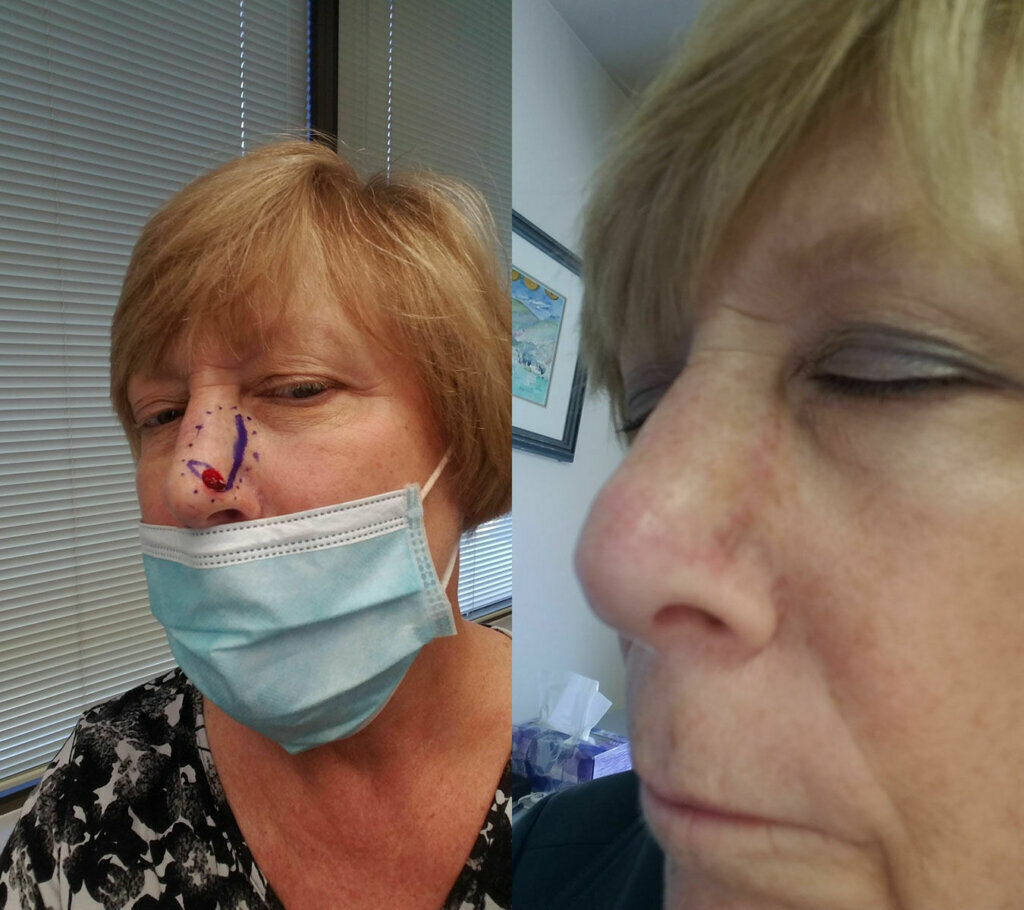
Now, weeks later, DeCarlo said she’s happy with the results.
“I just have a little teeny bit of swelling on the side of my nose,” she said.
A microscopically guided procedure known as Mohs surgery was used during the removal of DeCarlo’s cancer.
“It’s awesome because the surgeon takes the slice of the skin and examines it in the laboratory, and you know that day that all of the cancer has been removed, so it’s not like you have to wait and see,” DeCarlo said.
The analysis happens in real-time, and if it determines that any cancer remains, the surgeon can return to the operating room as many times as needed.
“It’s for skin cancers that are on cosmetically and functionally sensitive sites like the face, the hands, the feet, over the shin bone and even on the genitalia,” said Dr. Min Deng, director of Mohs micrographic surgery for MedStar Washington Hospital Center and Georgetown University Hospital.
Guidelines to address most skin cancers are typically a one-size-fits-all approach where the cancer is removed along with a 1 mm margin, which may or may not be enough.
“For some patients, that may be adequate, in fact that may be more than adequate — you may have removed more skin than you really needed to because the cancer didn’t truly extend that far out,” Deng said.
Because the Mohs surgery method preserves the maximum amount of healthy tissue, it also results in minimal scarring.
You can find tips for skin cancer self-exams and advice for identifying on Medstar’s website.