
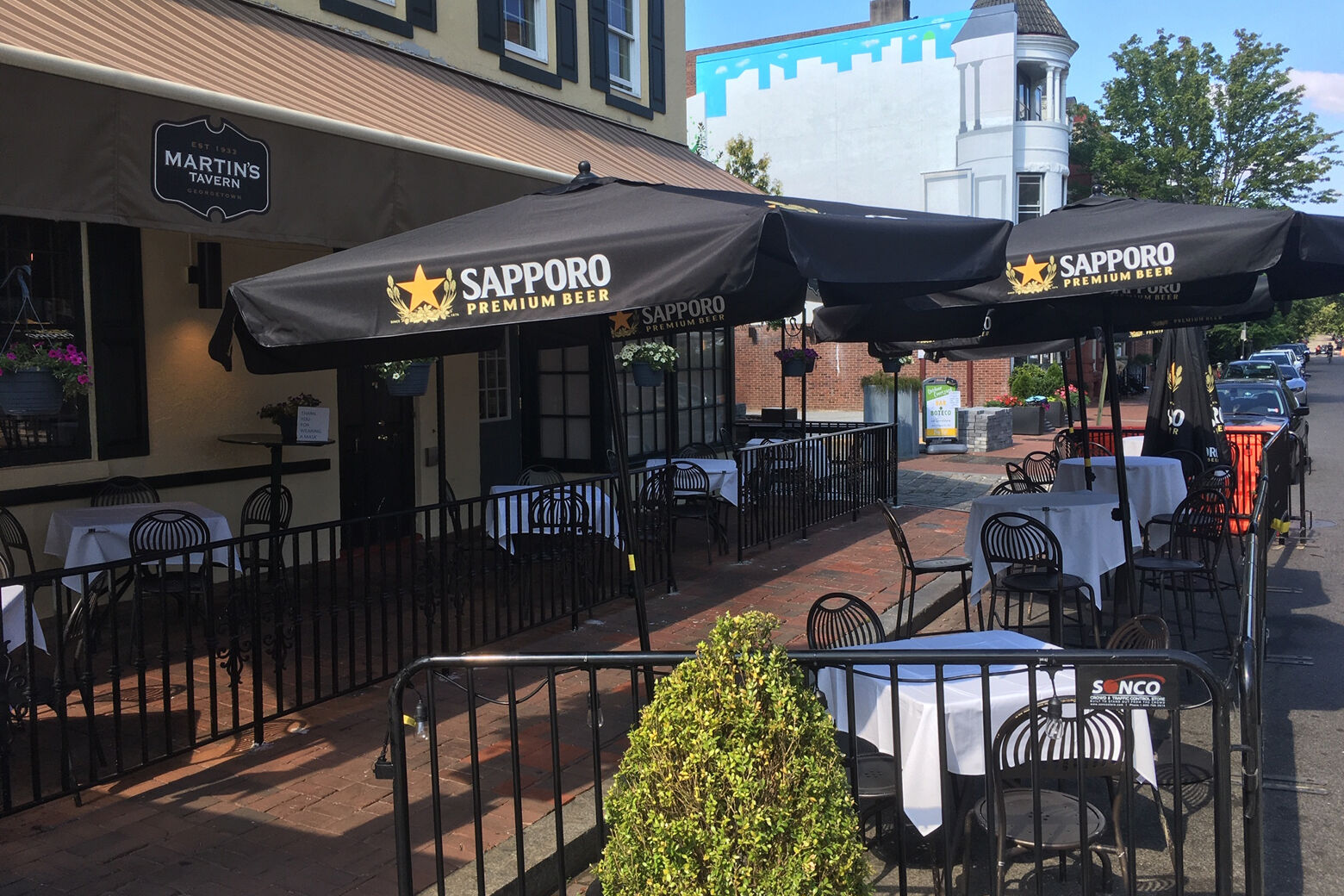
Several D.C. restaurants in Georgetown have a little more outside dining space joining the growing list of neighborhoods with “streateries” using street parking spaces for additional seating.
The Georgetown Business Improvement District helped restaurants apply for permits for the expanded outdoor space from the District Department of Transportation.
The BID also lent them materials to set up the extra dining space, and is working with additional businesses that are awaiting permit approval.
It is not a whole lot of additional space, but it helps.
BID-supplied barriers block off the equivalent of about two street parking spaces that don’t impede traffic flow — room for a few extra socially-distanced tables.
The Georgetown restaurants with street table permits include:
- Martin’s Tavern, at 1265 Wisconsin Avenue
- Susheria, at 3101 K Street
- Mr. Smith’s, at 3205 K Street
- The Berliner, at 3401 Water Street
- Il Canale, at 1065 31st Street
- L’Amexe, at 2917 M Street
- Piccolo and Flavio, on 31st Street South of Blues Alley
The Georgetown BID and DDOT are working on longer-term plans to widen Wisconsin Avenue and M Street sidewalks for social distancing by appropriating street parking spaces through at least Phase 4 of the District’s coronavirus reopening plans, which could be anywhere from this fall to sometime in 2021.
- Sign up for WTOP alerts
- Teachers collaborate on Virginia social studies curriculum with anti-racist focus
- Montgomery Co. schools seek more funding for mental health counseling amid pandemic
- Latest coronavirus test results in DC, Maryland and Virginia
- Coronavirus FAQ: What you need to know
- Coronavirus resources: Get and give help in DC, Maryland and Virginia
Looking for more information? D.C., Maryland and Virginia are each releasing more data every day. Visit their official sites here: Virginia | Maryland | D.C.