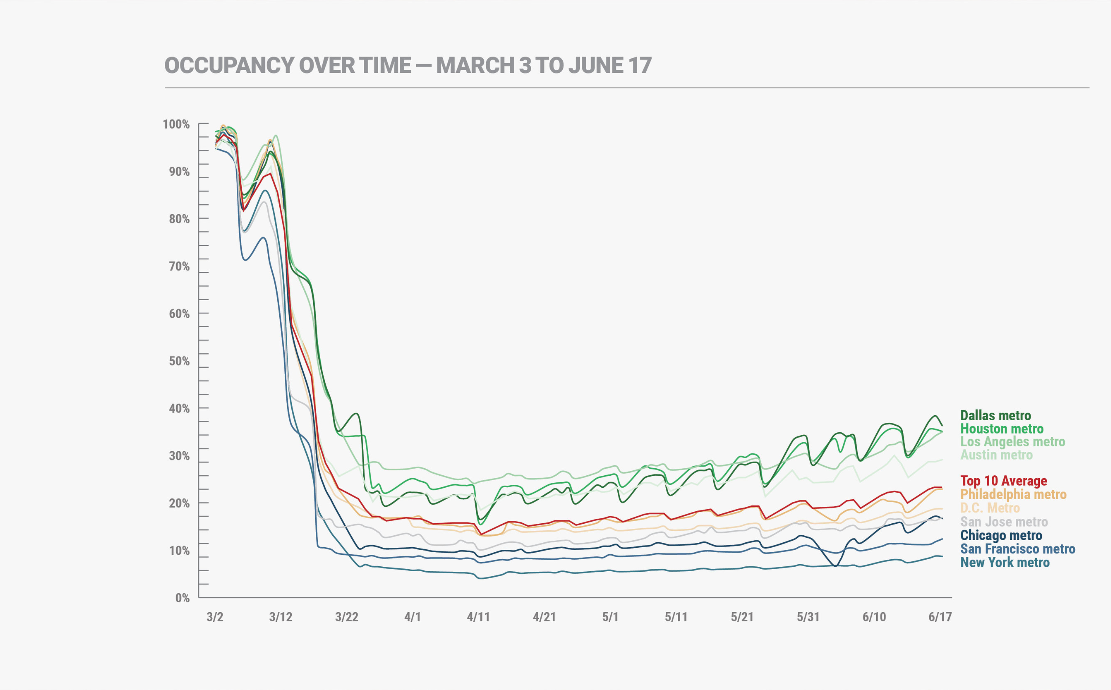
One way to measure how many office workers are going back to work is to track the number of building security card swipes and fob taps, and based on that data, the occupancy levels at D.C.-area buildings remain extremely low.
Falls Church, Virginia-based Kastle Systems, whose security systems are used by hundreds of buildings in the D.C. region, reports its Back to Work Barometer — which shows access to buildings using its systems — indicates an occupancy rate of 18.2% in the D.C. metro area as of June 17.
That is up, but not by much. D.C.-area office building occupancy was 14% in the first week of April, when most companies began widely adopting work-from-home policies. It was 96% in early March.
Kastle Systems, which does business in 138 cities, measured building access in 10 markets.
Elsewhere in the country, it notes occupancy rates began to tick up in Austin, Houston, Los Angeles and Miami in late May, and in Chicago and Philadelphia more recently.
Western and Southwestern cities like Dallas, Houston and Los Angeles are leading in terms of returning to the office.
“The question on everyone’s minds right now is when will it be OK to go back to the office,” Kastle CEO Haniel Lynn said.
“We are keeping a close eye on trends in occupancy data as part of our KastleSafeSpaces framework, which is designed to help office buildings safely reopen.”
Kastle Systems services about 1,200 buildings in the D.C. region, and is its largest metro area for coverage.
Below is a chart showing Kastle Systems employee entrance activation for select metro areas, courtesy Kastle Systems:
Editor’s note: This story has been updated to correct the spelling of Kastle’s CEO.