
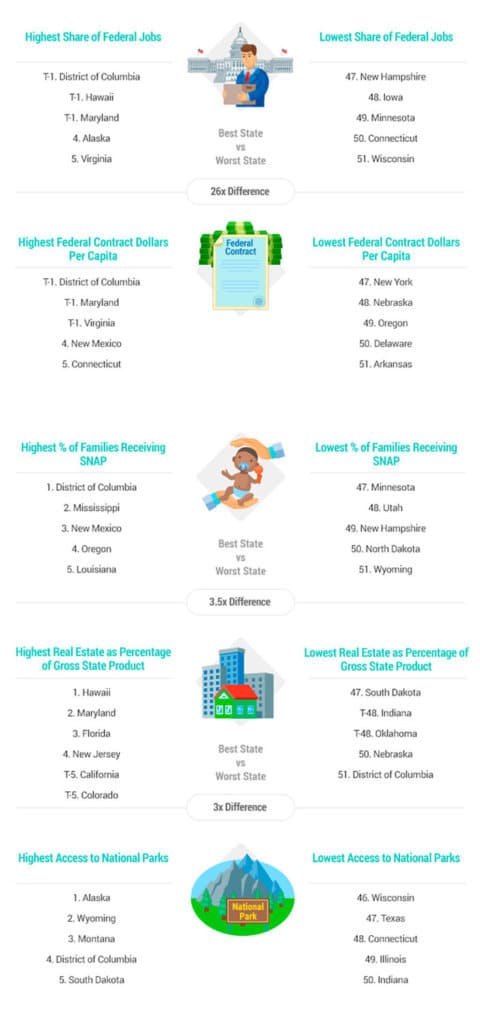
WASHINGTON — In perhaps non-shocking news, it turns out that D.C. is being affected the most by the current government shutdown. The runners-up, however, might be surprising. The federal government has shut down 21 times since 1976. Three of those shutdowns have been under President Donald Trump’s administration, though the first lasted only a couple of days and the second a few hours. The longest (so far) started in 1995 because of a clash between then-President Bill Clinton and Congress over a spending bill Clinton vetoed because it didn’t align with his objectives for education, the environment, Medicare and public health. It lasted 27 days in total and Republicans — Newt Gingrich in particular, due to his “temper tantrum” — famously bore the brunt of the blame. [custom_gallery] The 2018-2019 shutdown, entering its 13th day Thursday, also revolves around government spending. This time, it’s ostensibly centered on funding for Trump’s signature campaign pledge to build a wall along the U.S.-Mexico border. Businesses in Washington have been eerily quiet since the shutdown started. And most federally funded locations in D.C. are closed. But the impact of the shutdown is being felt far beyond the borders of the District. According to a WalletHub report, New Mexico is the second-most impacted by the shutdown, right after D.C., due to the share of federal jobs to federal contract dollars per capita and the share of families receiving food stamps. Third is Maryland. Fourth is Hawaii. Alaska is fifth, with Virginia coming in sixth.[related_gallery align=”right”] At the very bottom of the list, hit the least, is Minnesota. “To measure the relative impact of the January 2019 partial government shutdown on each state, as well as the District of Columbia, WalletHub identified five basic metrics that speak to how people across the country will be affected by the absence of government services,” the report reads. WalletHub says it “analyzed publicly available data from official sources to score the shutdown’s impact by state” to reach its conclusions. “Each metric was scored on a 100-point scale, with 100 representing the biggest impact from the government shutdown. We then determined each state and the District’s weighted average across all metrics to calculate its overall score and used the resulting scores to construct our final ranking.” That rubric is based on the share of federal jobs, federal contract dollars per capita, the percentage of families receiving food stamps, each area’s real estate as a percentage of the gross state product and access to national parks. See an interactive map with the full results below.
The Shutdown is only because of the 2020 Presidential Election. The Democrats know they can’t win based on all of the achievements of “Trump,” so they are going all out on the desperately needed Wall and Border Security – and Presidential Harassment. For them, strictly politics!
— Donald J. Trump (@realDonaldTrump) January 3, 2019
Democrats have vowed to pass legislation restoring the government as soon as they take control of the House on Thursday, but that won’t accomplish anything unless Trump and the Republican-controlled Senate go along with it. The shutdown has forced hundreds of thousands of federal workers and contractors to stay home or work without pay. WalletHub used data from the U.S. Census Bureau, the U.S. Bureau of Labor Statistics, usaspending.gov, the National Association of Realtors and National Park Service. The Associated Press contributed to this report.