WASHINGTON — The most stolen car is 20 years old.
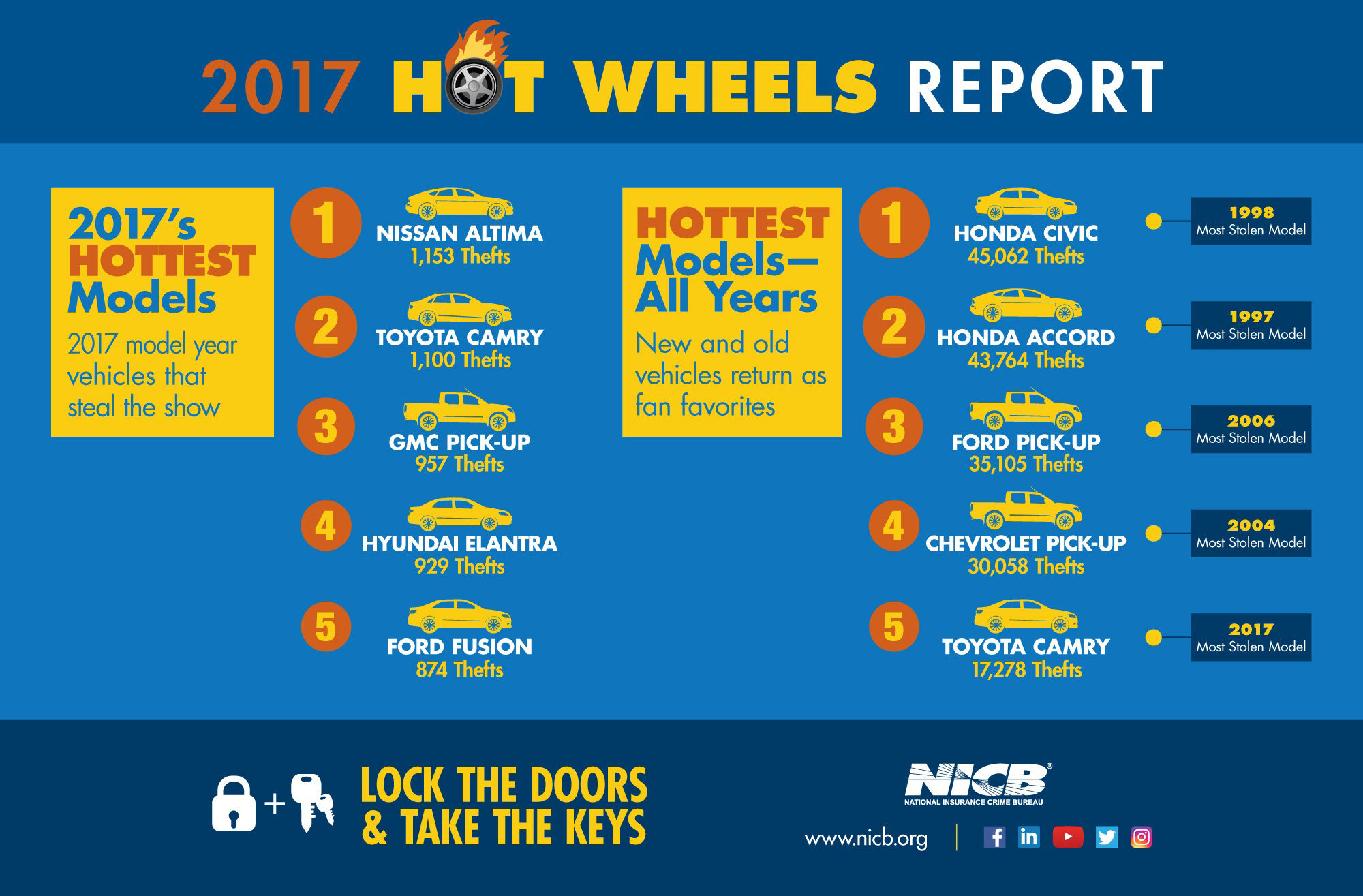
The National Insurance Crime Bureau’s “2017 Hot Wheels Report” of the most-stolen cars in the U.S. last year is topped by the 1998 Honda Civic.
Why is a 20-year-old car the most stolen vehicle?
There are many still on the road and thieves want them for parts. But many of the most-stolen vehicles are older models because they predate effective anti-theft technology.
The NICB notes that, while 6,707 1998 Honda Civics were reported stolen in 2017, just 388 2017 Honda Civics were stolen. That means there are 17 1998 Civics were stolen last year for every 2017 model.
Four of the ten most stolen vehicles last year were pre-2005 models. In addition to the ’98 Civic, the 1997 Honda Accord ranks No. 2. The 2004 Chevrolet pickup is No. 4 and the 2001 Dodge pickup is No. 8.
The most stolen 2017 model last year was the Nissan Altima, followed by the Toyota Camry, GMC pickup, Hyundai Elantra and Ford Fusion. It should be noted that those are also some of the top-selling vehicles, meaning they are popular and there are more of them on the road for thieves to choose from.
The NICB compiles its annual report based on vehicle theft data submitted by law enforcement to the National Crime Information Center.
NICB says even with slight increases in vehicle thefts in the last few years, vehicle thefts today are at levels not seen since 1967, largely because of enhancements in vehicle security and manufacturing.
But that technology doesn’t work if drivers don’t use it. Thousands of vehicles are stolen each year simply because owners leave their keys or fobs in the vehicles.
NICB says the most effective anti-theft devices include visual and audible warning devices, immobilizing devices like kill switches and smart keys and tracking devices.