
WASHINGTON – A North Carolina family finally got to thank the woman who saved their 7-year-old son’s life Sunday, two years after a critical bone marrow transplant.
The Sandi family’s story is especially poignant since their young daughter died from leukemia, the same disease that was killing their son — until a stranger stepped in with a lifesaving donation.
The meeting happened just before the start of the D.C. Walk/Run for Life 5K at Hains Point in East Potomac Park.
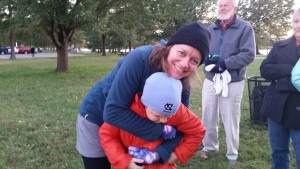
Phineas Sandi was on stage with his mom, dad and older sister when he met 25-year-old Ashley Lowe for the first time.
25 yr old woman meets 7 yr old boy for 1st time after giving him a life-saving bone marrow donation 2 yrs ago.@wtop pic.twitter.com/PV1pFO3YhQ
— Kathy Stewart (@KStewartWTOP) October 18, 2015
Big hugs were exchanged, and a few tears were shed.
“Honestly, every single day I think about him and you, just hoping that he’s getting healthier and stronger,” Ashley told the Sandi family, “So being here with everyone is just absolutely incredible.”
Phineas Sandi survived against the odds. He had a rare case of Leukemia that did not respond to standard therapies. In a last-ditch effort to save his life, Phineas’ parents took him to the National Institutes of Health for an investigational immunotherapy treatment that was in its very early stages.
“It worked, and as soon as we got him in solid remission we went and got him a bone marrow transplant at the University of North Carolina,” Phineas’ dad, Carlos Sandi, says.
The Sandi family put all their hopes, and trust, in the hands of an anonymous donor.
“It’s pretty incredible,” Carlos Sandi says. “One of the scariest parts of the transplant process is they basically eliminate any chance that you are going to live another two weeks unless that person shows up to donate their marrow.”
Meanwhile, Ashley Lowe is still humble about helping save a young life. “It’s so hard to think that’s what I did,” she says.
Two years on, Phineas is doing incredibly well.
“You see him running around. At this point he’s just a typical seven-year-old boy, which is part of the mundane miracle aspect,” his dad tells WTOP. “He’s growing, but as healthy as any the kids in his class. We don’t go in for follow-up treatment at all. He gets one-year exams.”
Phineas’ mother, Tina Sandi, couldn’t wait to hug the woman who basically gave her son a second shot at life. “I’m emotional but it’s a beautiful day,” she says.
The DC Walk/Run for Life 5K raises awareness and funds for bone marrow and blood stem cell donations. The money raised goes to adding new donors to the international bone marrow registry.
Joining the registry is simple, it just requires a cheek swab and then the test kit is sent to the lab. But it costs $60 to process a single donor test kit, so fundraising is vital to ensure that other patients like Phineas can find suitable donors.
