
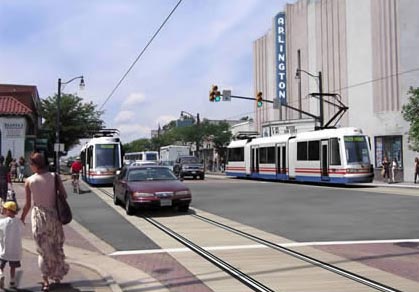
 (Updated at 10:20 a.m.) Del. Patrick Hope, Democratic candidate for Congress, and Alan Howze, Democratic nominee for Arlington County Board, joined forces yesterday to call for a voter referendum on the Columbia Pike streetcar.
Hope and Howze are both streetcar supporters, but they said the controversial issue should be put to a referendum so that “we can put the streetcar debate to rest.”
Arlington County in the past has said that a referendum could not be legally held since it’s not planning on funding the streetcar via bonds. Hope and Howze, however, point out that an advisory or binding referendum could be held if approved by the Virginia General Assembly.
The candidates released the following statement on their referendum push yesterday afternoon.
Delegate Patrick Hope (D-47 and candidate for VA-08) and Alan Howze (Democratic Nominee for Arlington County Board) joined together to call for the Arlington Streetcar project to be put to a public referendum. Both Hope and Howze have been on the record supporting the streetcar- and continue to do so- but believe the citizens of Arlington need to have a referendum to make the final decision.
“This issue has clearly divided the Arlington community”, Patrick Hope said. “It’s time to move forward and have a public referendum to settle this issue. I represent parts of Columbia Pike in the General Assembly and I support major transportation investments in that corridor that will ease congestion and stimulate job creation and economic development. We need to move forward quickly with those improvements and I believe a referendum on the streetcar is the only way to settle this issue once and for all. The time has come for a full public debate on this issue and we need to respect whatever the public decides.”
“As we have done with Metro, Schools, the Water Pollution Control Plant, and other important community investments, we should give voters the final decision through a public referendum vote”, Alan Howze noted. “I continue to support the streetcar project because of the broad transportation, economic and environmental benefits it will provide for our community. I heard the concerns expressed by voters in the recent special election, and we can put the streetcar debate to rest and ensure public confidence by allowing a referendum vote.”
There are multiple options for the Arlington County Board to consider regarding a referendum and both Hope and Howze are open to whichever one the Board decides would be the best way for voters to weigh in on the streetcar. These include voting on the streetcar in the 2014 general election through the County’s transportation bond or an advisory referendum that may need General Assembly approval.
Democrat Mark Levine, who is also running to replace Rep. Jim Moran in Congress, said last week that he supports a voter referendum on the Columbia Pike streetcar.
Howze’s opponent in the November Arlington County Board election, meanwhile, released a statement that lauded the referendum idea but took a shot at Howze’s streetcar support.
Independent County Board member John Vihstadt, whose election was considered by some to itself be a referendum on the streetcar, is pushing for the county to halt all spending on the streetcar. He says that any referendum on the issue should be clearly worded.
I am pleased to see that Alan Howze now agrees that Arlington taxpayers should have a voice regarding the County Board’s misguided proposal to spend hundreds of millions of dollars to install streetcars in Arlington. I regret that Mr. Howze still believes that streetcars are a good investment for Arlington. Many people have already stated that my election on April 8 with 57 percent of the vote was referendum enough on the wisdom of Arlington streetcars. Yet, if a further specific streetcar voter referendum is to be truly meaningful and anything beyond a gimmick or a political tactic, it is imperative that the County Board direct the County Manager immediately to cease all County expenditures relating to streetcars, as I attempted to do at our April 16 County Board work session. Not a penny more of taxpayer dollars should be spent on promoting, planning for, or in any way implementing Arlington streetcars until such a referendum is held and Arlington voters have had their say once again.
Accordingly, I call on Delegate Hope and Candidate Howze, as well as my Board colleagues, to support my and colleague Libby Garvey’s efforts to ensure that (a) no funds shall be expended in the FY 2014 or FY 2015 operating budgets for the purpose of furthering a streetcar on Columbia Pike or anywhere else in Arlington, except to the extent that such expenditures are required to meet contractual or other legal obligations entered into by the County prior to the date of this motion; (b) no funds be included in the FY 2015-2024 Capital Improvement Plan (CIP) for similar purposes and that (c) any referendum question on streetcars to be included on the general election ballot in Arlington in 2014:
- be clearly worded to specify in detail the estimated total costs for all proposed Arlington streetcars,
- detail the proposed financing plan for all of them, and
- not combine streetcar financing with any other project so that it is clear to voters precisely on what subject they are voting.
County Board Chair Jay Fisette told the Washington Post that he wasn’t sure a streetcar referendum was such a good idea.
“I lived in California for a while when we had 100-plus referenda on the ballot,” Fisette told the paper. “I became very disillusioned about the use of selective referenda on public policy issues.”
