
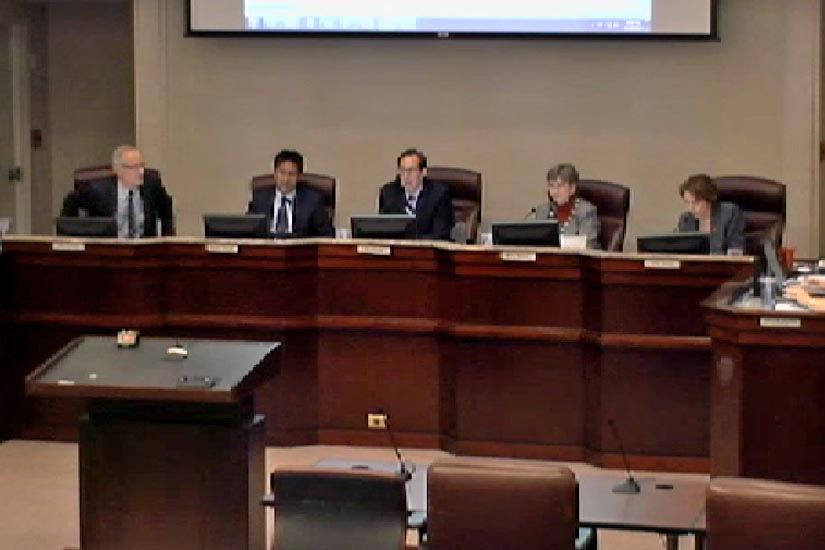
 The Arlington County Board adopted a $1.15 billion budget Tuesday night.
The Fiscal Year 2015 budget trims one cent from the county’s real estate tax rate while — thanks to a rise in property assessments — adding funds for schools, road paving and high speed fiber optic infrastructure. It also maintains service levels in other areas of county government.
The real estate tax rate is now $0.996 per $100 in assessed value, bringing the annual county tax burden on the average Arlington homeowner to $7,327.
The budget includes merit pay raises for county employees, which the County Board added back into the budget after an outcry from police and firefighter employee associations.
The Board, including newly-elected member John Vihstadt, voted unanimously for the budget. Vihstadt, who was elected on a platform of fiscal responsibility, said he was pleased with the tax rate reduction and did not want “to let the perfect be the enemy of the good” in budget deliberations.
Two other Board members echoed that sentiment in voting for the budget. Libby Garvey said she didn’t approve of the budget’s cut to mental health services for prison inmates (a grant that funded an employee for that task had run out) and accused the Board of squirreling away transportation money in various funds with the intention of, at some point, using it for streetcar projects, which she opposes.
Walter Tejada spoke out against budget guidance that directs the county manager to study the possibility of privatization and outsourcing Volunteer Arlington, which promotes and coordinates volunteer opportunities.
Other budget guidance for the manager (which was added by the Board outside the normal public budget process) included:
- A request for a report by the end of the year on the financial sustainability of Artisphere
- Enhancement of the county’s internal audit functions and the establishment of a fraud and waste hotline
- Improved parking ticket adjudication for tickets issued in error
- A plan for a phased implementation of staffing increase for the county’s police, fire and other public safety departments
The county’s press release on the budget passage, after the jump.
The Arlington County Board today adopted a $1.15 billion General Fund Budget for Fiscal Year (FY) 2015, cutting one cent off the real estate tax rate while adding funding for schools and year-round yard waste pickup to the County Manager’s Proposed Budget.
“This Budget maintains key services, preserves our social safety net, and adds funding for Schools, while giving some relief to homeowners who will see their real estate taxes rise as a result of increased assessments,” said Arlington County Board Chair Jay Fisette.
The Board voted 5 to 0 to adopt the Budget. Fiscal Year 2015 begins July 1, 2014.
In balancing the budget, the Board included a real estate tax rate of $0.996 per $100 of assessed value, a one-cent decrease from the $1.006 rate in Calendar Year 2013 (including the sanitary district tax). This is a $6.6 million reduction in real estate tax revenues from the budget proposed by the County Manager. County operations, not Schools, will absorb the full cut.
The County’s Operating and Capital Budget will increase 4.6% from the FY 2014 Adopted Budget, while Schools funding will increase 6%.
Average tax and fee burden to increase 4.6%
Arlington’s real estate tax rate remains the lowest in the region. Under the Adopted Budget, the “average” Arlington homeowner (with a home valued at $552,700) will see their overall tax and fee burden rise 4.6%, about $27 a month, or $324 a year.
This reflects the 5.3% increase in the average residential property assessment and a 3.4% increase in the water-sewer rate. The household solid waste rate also will increase by 4%. Part of that increase will fund, starting in July 2014, year-round collection of yard waste – a service provided by nearly all of Arlington’s neighboring jurisdictions.
Increased funding for Arlington Public Schools
The Board maintained the County’s commitment to keeping Arlington Public Schools among the nation’s finest. It provided a total of $440.6 million to Schools for the FY 2015 Budget, adding $19.6 million to base funding and another $8.4 million for school construction or other one-time expenses. The Board also added funds for another school clinic aide and three new School Resource Officers. Under the FY 2015 Budget, Arlington’s support for our students now exceeds $19,000 per pupil – more than any other school district in the region.
Strategic Investments with one-time funds
The Board provided funding for several key efforts. Highlights include:
- Economic stabilization fund ($3 million)
- ConnectArlington, to provide high speed fiber connectivity for Arlington businesses and to accelerate economic development ($1.6 million)
- Tourism marketing ($200,000)
- Numerous social safety net priorities, including staffing and operating costs of the new Homeless Services Center, expected to open in early 2015 ($700,000); $500,000 above this year’s funding for affordable housing; a new sexual assault hotline ($52,000) a mental health coordinator to train first responders and the judiciary ($72,606).
- Overtime for additional police to manage pub crawl enforcement ($42,000)
- Continuing Police participation in the regional gang task force ($25,000)
The Board also accepted the Manager’s proposal to fund merit step increases for employees, while incorporating a hiring slowdown that will reduce FY 2015 expenses.
To learn more about the FY 2015 Budget, visit the County website.
