
 On Monday, 102 runners from Arlington crossed the finish line at the Boston Marathon.
It was the first running of what many view as the world’s premier distance race since last year’s race was marred by the bombings that killed three and left hundreds injured.
Michael Wardian was the top finisher from Arlington, finishing in 2:23:32, good for third in the 40-44-year-old men’s division and 44th overall. Wardian, who turned 40 on April 12, won the North Pole marathon by nearly an hour less than two weeks ago and completed two other races — the GW Parkway 10 Miler and a 5K — between then and Monday.
 Wardian is an elite runner who runs dozens of races each year, but he said this year’s Boston Marathon was unique – the excitement level among the spectators was off the charts.
“People are screaming and the energy is so amazing,” he said. “For me it was super emotional coming down the final stretch and crossing the finish line. I couldn’t ask for anything more. It was such a special day and a great day to be a runner.”
“The whole reason I got into running 20 years ago was to get into the Boston Marathon,” he said. “It’s an honor to just be a part of it.”
Arlington’s top female finisher was Clarendon resident Kayley Byrne, 26, who finished in 3:09:05, putting her in 322nd among all women and 267th in her division.
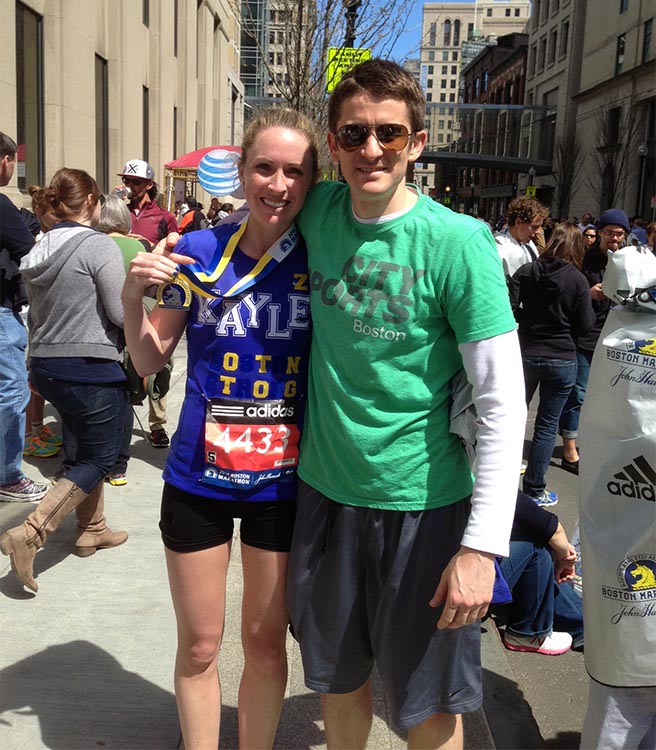 Byrne, a William and Mary alum who’s getting married in August, ran the marathon for the third time in a row — and for the second time with her mother, Carol. The two ran the Boston Marathon last year and Carol finished just 7 minutes before the bombs went off. Carol was uninjured, but shaken up.
Afterward, Byrne recalls watching the news coverage in their hotel room, stunned at how such a joyous event had turned so tragic so quickly. Then they made a pledge.
“We were like — we have to go back,” she said.
Byrne said running the 26.2 mile course this year “was completely inspirational.”
“There were people lining the course the entire way,” she told ARLnow.com. “Everyone was wearing Boston Strong shirts. It wasn’t so much about the race but a celebration of Boston and of running. There was a huge sense of community throughout the entire race and the entire weekend.”
Wardian’s next race will be the picturesque Big Sur marathon in California on Sunday. Byrne said she’s “feeling pretty beat up today,” but is looking forward to some day competing in the two World Marathon Majors she has yet to run, London and Berlin.
After the jump, in order of finish, are Arlington’s top 20 finishers in Boston from Monday.
- Michael Wardian, 40, 2:23:32
- Eddie Valentine, 34, 2:32:51
- Marty McCormick, 34, 2:37:06
- Ian Blackwell, 27, 2:39:04
- Andrew Whitacre, 28, 2:44:59
- Jeramia Cibulka, 33, 2:45:38
- Andy Cahoy, 27, 2:47:58
- Charles Engle, 43, 2:48:51
- Albert Kim, 36, 2:54:21
- Marshall Martin, 28, 2:54:29
- Justin McCarthy, 32, 2:55:13
- David Barr, 28, 2:56:51
- Thomas Johnson Jr., 28, 2:57:04
- Andrew Orzel, 36, 2:59:47
- Vince Jesaitis, 35, 2:59:48
- Ben Shea, 35, 3:00:22
- Steven Maguire, 47, 3:00:36
- Matthew Clark, 30, 3:00:49
- John Kelly, 30, 3:01:48
- Jonathan George, 30, 3:02:19
- Bradley Smith, 38, 3:03:36
Other finishers, in order of finish: Mark Fiegener, Matthew Cypher, Kayley Byrne, William Schaffer, Peter Bredemann, Michael Daley, John Kendra, Andrea Nelson, Jacqueline Wilkins, Melinda Metz, Paul Matheson, Jacob Brundage, Melanie Brown, Reynolds Wilson, Alison Smith, Julia Taylor, Jay Jacob Wind, James Donahue, Gregory Wood, Julie Chavanne, Caroline Lewis, Tammy Lamantia, Jessica Boucher, Taneen Carvell, Faith Korbel, Norris Cochran, Bo Bloomer, Pamela Walsh, Ryan Bieshaar, Kate Skidmore, Frank Fumich, Taylor Coffey, Audrey Anderson, Mallory Scott, David Lee, Grace Chan, Mary Freeman, Daryle Lademan, Joseph Scanlin, Jacqueline Pau, Will Ellison, Jeff Bedell, Amie Heap, Brittany Williams, Emily Rhoades, Elke Horne, Laura Danberg, Kym Rybold, Sarah Mennone, Abhaya Menon, Lauren Gabler, Alexandra Barrage, Anthony Barnes, Cathy Ahn, Steve Messinger, Robert Sindermann Jr., Patrizia Maness, Mark Henneberger, Jackie McCarthy, Mary Gibson, Julie McTernan, Jessica Summers, Deb Ryan, Gary Morgans, Anthony Demario, Jacqueline Nivet, Caroline Merena, Kate Bernier, Robert Loeb, Lisa Leonard, Cindy Walls, Jose Braz, John Simpkins, Daniel Tiernan, William Carty Jr., David Cote, Brenton Wetmore, Samantha Lauring, Suzanne Garwood, William McKenney, Megan McCluer.
