
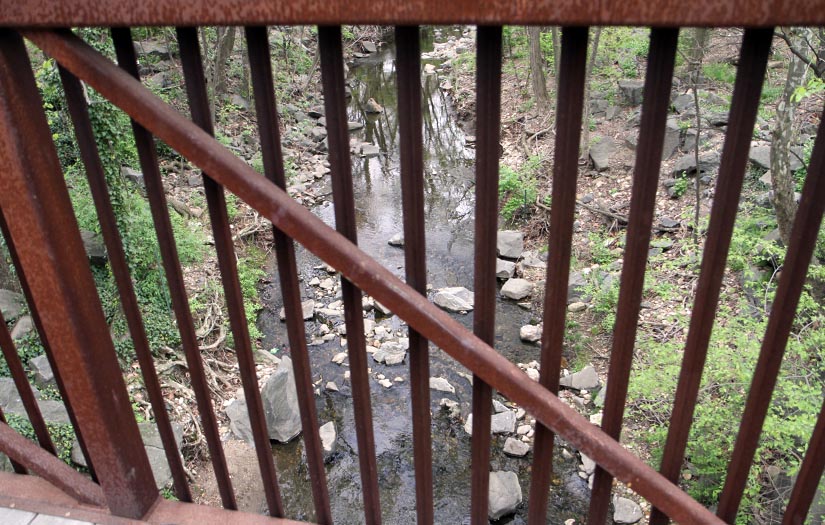
 August brings the eleventh anniversary of the most notorious stream pollution incident in Arlington County history. In the years since golf course runoff poisoned the Donaldson Run and Gulf Branch streams, residentss and county officials alike have stepped up their protection of our region’s waterways.
In August 2001, an herbicide applied to 12 fairways at the Washington Golf and Country Club washed into Donaldson Run and Gulf Branch after a storm. Eight thousand pounds of this herbicide, Basamid G, had been applied to kill all plant and animal life in the top two inches of the fairways’ soil. However, it did a whole lot more than its intention. The runoff killed an estimated 1,000 American eels. No living organisms were found in the streams following the storm.
Jen McDonnell, a Stormwater Outreach Specialist at Arlington’s Office of Sustainability and Environmental Management, said the incident “brought attention to the impacts that runoff can have on our streams.”
After this event, golf course officials agreed to halt the treatment of the remaining six fairways, which would drain into Gulf Branch. In 2005, facing civil charges, the golf course agreed to a consent decree in which it paid $145,000 to reimburse the costs incurred by the federal government — specifically, the National Park Service and the U.S. Fish and Wildlife Service – in responding to the incident.
Arlington County code makes it unlawful for “any person to discharge directly or indirectly into the storm sewer system or state waters, any substance likely, in the opinion of the County Manager, to have an adverse effect.”
McDonnell said that she is “not aware of any other penalty fines which have been paid for stream pollution.” However, she does know that polluters oftentimes have to pay for cleanup activities following a spill.
Despite the threat of financial consequences, pollution still continues, often unknowingly, from residents applying pesticides and fertilizers onto their lawn. The county and some environmental groups have been trying to counter the contamination with various stream-friendly projects.
In 2005, the Arlington County Board approved a contract to begin restoration of more than a half mile section of the Donaldson Run Stream in Zachary Taylor Park. This $1.5 million project was initiated by the Donaldson Run Civic Association (DRCA). The DRCA received a $75,000 grant from Virginia’s Department of Conservation and Recreation for the project, so the group did not have to foot the entire bill.
Anne Wilson, President of the Donaldson Run Civic Association, said that the project was a “great success” and “improved the long term health of the stream and the waters it flows into.”
In 2008, the County Board approved a sanitary district tax to fund improvements in the stormwater system. Stormwater picks up many pesticides, fertilizers, and soaps from car washes as it makes its way to storm drains and thus infects our streams. The average Arlington homeowner pays about $75 for this tax per year.
There have been numerous other programs and projects funded by the county in an effort to reduce stream pollution. Arlington has completed two Green Street projects, and there are several more in design. Green Streets use a vegetated landscape to capture storm water runoff and breakdown pollutants before they can enter a stream.
The Stormwater Wise Landscapes Program is a pilot program offered in partnership with the Arlingtonians for a Clean Environment. It not only guides, but funds Arlington residents to implement run-off reducing practices in their own yard.
Arlington’s Office of Sustainability and Environmental Management coordinates a volunteer stream monitoring program. The volunteers meet monthly to collect water samples and monitor the variety of macro-invertebrates in our streams to determine if the water is impaired. The data is then given to the Virginia Department of Environmental Quality.
Arlington also recently hired a professional team to also monitor the streams.
“Their data reinforced what our citizen monitoring data had indicated, that Arlington’s streams are severely stressed due to non-point source pollution,” McDonnell said.
These projects are essential not only to stream health, but to Arlington residents’ health as well.
“Many of Arlington’s residents come into contact with Arlington’s streams through recreational activities… we want to keep bacteria and nutrient levels within a range that does not pose a health risk to residents or their pets,” McDonnell said.
Arlington residents hoping to do their part to protect our steams can take several simple steps at home, including:
- Washing cars with biodegradable soap
- Picking up after pets (e-coli from pet fecal matter can easily wash into streams)
- Not putting fats, oil, or grease down the sink as it can cause a sewage backup
- Learning how to install a rain barrel — which helps to prevent moderate stream erosion — at one of the many rain barrel workshops offered in Arlington County
