
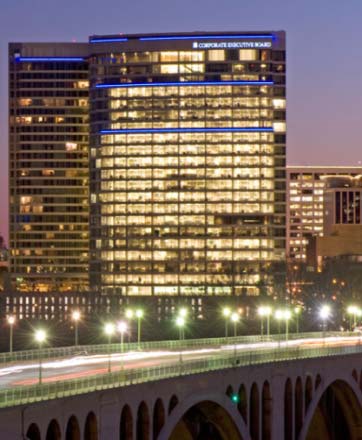
 There’s been a large scale revamp of the sign regulations in Arlington’s Zoning Ordinance. The County Board approved changes to the ordinance during a marathon meeting last night (Tuesday) that stretched into early this morning.
The effort is intended to clarify gray areas, modernize the regulations and to make them easier for everyone to understand. Major issues included signs placed in the public right-of-way by private parties, the County Board’s involvement in reviewing sign requests and regulations for roofline signs.
Board members Walter Tejada and Chris Zimmerman pushed for a ban on commercial roofline signs — those installed above a height of 40 feet — but it didn’t pass. The county Planning Commission favored the ban, but county staff recommended keeping the signs and the other three Board members ended up siding with staff.
The Board acknowledged the difficulty of resolving the issue and pleasing all involved parties; speakers representing business interests (and some residents) at the meeting spoke in favor of keeping the signs, while a number of residents said they’d like them removed.
“We are being overwhelmed by this development,” said resident Jim Hurysz, speaking against rooftop signs. “If I wanted to live in downtown Las Vegas, I’d live there.”
“I like signs. I look for signs to know where I am. It’s useful, it’s attractive,” countered Rosslyn resident Valerie Crotty. “You’re not living in a suburb. You’re not living in a rural area.”
“All of these companies are now asking themselves ‘does Arlington not want us here?’” said Arlington Economic Development Commission member Marty Almquist. “‘Are they embarrassed that we’ve decided to locate here? Are they not interested in this live, work, play concept that has been touted for the Metro corridor?’”
“In the past, Arlington could rely on companies to relocate here,” Almquist continued. “That will all change when the Silver Line opens in 2013. Tysons Corner and Reston are going to be Metro accessible….that means Arlington needs to have at its disposal a variety of incentives to our tenants to persuade them to move here or stay here… one of those incentives needs to be signage.”
Board member Libby Garvey supported the signs, saying they distinguish Arlington and highlight its exciting atmosphere as an urban village.
“It’s so hugely personal,” Garvey said. “To me, if they’re done well, the sign, it gives the building a personality.”
Under the new regulations, businesses will have to limit the use of lighted signs to 8:00 a.m to 10:00 p.m. (a midnight cut-off was originally proposed) if they face national monuments or lands, such as Arlington National Cemetery or the National Mall. Those signs also will be limited to only one per facade. The Board approved limiting the brightness of lighted signs that are within 100 feet of residential high rises.
Board member Jay Fisette noted that whether for or against lighted signs, addressing the issue in the ordinance is “evolutionary.” Previously, the county did not have any set standards for these types of signs.
Existing signs that had been previously approved but may not meet the new standards will be grandfathered in, at least for now.
Much of the approval process for new signs will now lie with county staff, instead of needing Board approval. It was noted that this provision is not designed to allow the approval of a higher percentage of signs or to make the regulations less stringent, it’s simply to reduce how often individual sign issues have to go before the Board, so members are freed up to deal with other issues. Small businesses had frequently expressed disapproval of the length of time involved with the sign permitting process, considering 30-40 percent of them had to be approved by the Board.
 The final point garnering attention dealt with signs in the public right-of-way. Under the new regulations, temporary signs advertising lost pets or community events — such as a meeting or spaghetti dinner — will be allowed provided they meet size requirements, are secured to the ground, and placed for no longer than seven consecutive days. Noncommercial signs that aren’t secured to the ground — like most A-frame signs — would be prohibited in the public right-of-way, but will still be allowed on private property.
The process of updating the signs regulations in the Arlington County Zoning Ordinance has been ongoing since December 2010. County staff members gathered input on the three revised drafts at a number of public hearings and workshops, before presenting the Board with the final proposal last night.
Despite nearly six hours of back-and-forth debate on individual aspects of the ordinance, the Board eventually unanimously voted to approve it.
“I think it is not perfect, and I think it is like anything, going to change. But I’ve been unhappy with the sign ordinance in this county since I first got involved with the Board,” said Zimmerman. “I do think the bulk of this is a real step forward for the county.”
